
Fresh out of secondary school, students often move into rooms in shared houses, as they begin their new adventure together. Of course, these rooms preferably need to be affordable. And according to Frans-Pieter de Jong from the DUWO housing corporation, that can be quite a problem. ‘Student rooms aren’t independent homes, which means it’s not possible to apply for housing benefit. So, although it may be great all living together like that, it makes the rooms relatively expensive.’ DUWO came up with a solution: small apartments with the name STING. It stands for Students-IN-a-Group.
Sociable and affordable
On the top three floors of the 30 m high block of housing, there will be 42 of these STING apartments. Measuring just 18 sq. m., they are hardly spacious, but this is offset by the large communal space complete with kitchen on the same floor. They also have their own bathroom and mini-kitchen, and therefore their own address, which means it is possible to apply for housing benefit. De Jong: ‘An attractive rent combined with the sociability of a student house – it’s the best of both worlds.’
Balance
The STING is perfect for students just starting out, the larger Studettes (18-24 sq. m.) and Studios (at least 24 sq. m.) are more suited for Bachelor’s and Master’s students respectively. This is based on the idea that students have an increasing need for independence and space as they progress towards graduation. ‘Because we’ll be offering these different flat styles, the different students will end up living together’, explains De Jong. ‘This will result in a nice, lively balance.’
Buzzing downstairs
The bottom floor, the plinth at street level, might even be buzzing with activity. To enable this, Mei architects and planners have designed a multifunctional space, with room for such things as a launderette and bicycle storage facility. It will also include a commercial area that could be used in various ways, for example as a ‘bike bar’, where you can have your bike repaired. ‘The space has been designed to be as transparent as possible, creating an automatic connection between the various functions in the plinth’, explains architect Geert Krusemann. ‘As you enter the building from Hildegard von Bingenstraat, you can also already see the lovely green Florence Pricehof at the rear.’
The urban look
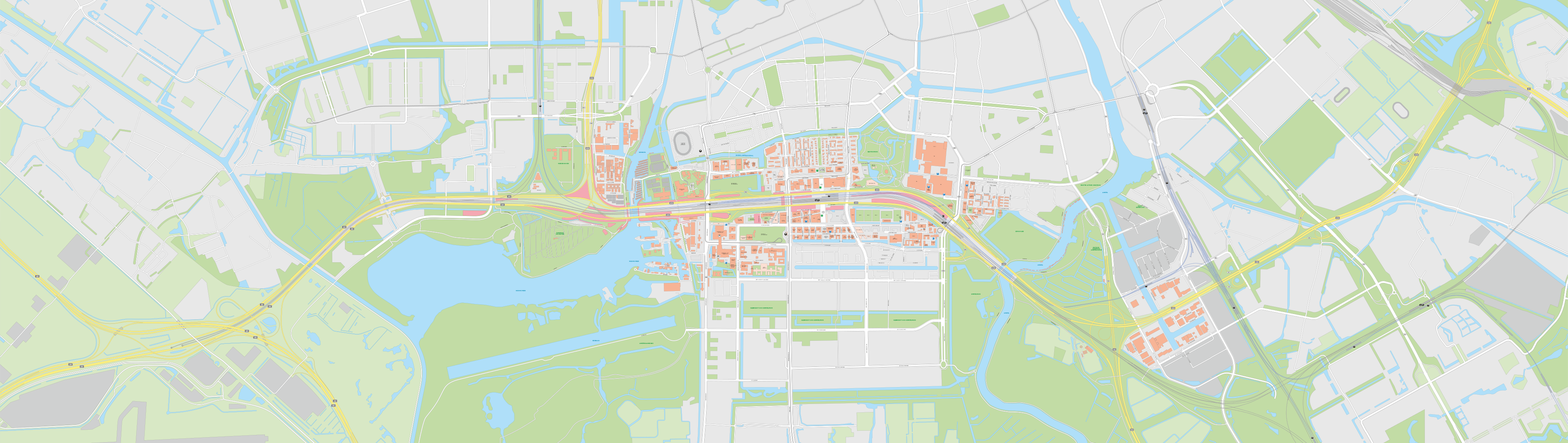
The architects have also come up with something for the exterior. The front of the building in Von Bingenstraat (the street running diagonally on the map) has a solid, urban look, with window frames of different depths that are not quite parallel to each other, shifting the perspective slightly upwards. The closer you get to the front of the building, the more refined it appears to be. According to Krusemann, the idea was borrowed from the Italian architect Scarpa: ‘From a distance, all you can see is a building, a big rectangular shape on the ground. Slightly closer up, you can see how refined the material on the façades really is. And when you’re face-to-face with it, you suddenly notice all kinds of unusual details, in the glazed ceramic tiles, for example. We’re designing them together with an artist, something we already have a lot of experience with.’
Birdsong
By contrast, the rear of the building will look much more informal. The façade will feature setbacks, slight recesses in it that create space for planters and nest boxes – what could be better than waking up to the sound of birds chirping? The cladding will also be made of materials like bamboo, built using circular methods as far as possible. What is Krusemann’s thinking behind this? ‘A building’s main structure can last for up to 150 years, but the façades deteriorate much faster. That’s why everything will be attached mechanically, without any adhesive or other binders. That makes things easier to remove.’
City palace
Student housing at the heart of Zuidas – it will probably not be the largest or most eye-catching building in this Amsterdam city district with international appeal. But, according to Krusemann, it offers plenty of other advantages: ‘It will be somewhere where generations of students can feel at home, built on a human scale.’ But with its extraordinary façade, two different faces and a lively plinth in the base, the building will definitely not look out of place. Hardly surprising, when we hear from Krusemann what inspired it: ‘During the design process, we always had the idea of the famous Italian city palaces in the back of our minds. You might even say it’s set to be a real student palazzo.’ Finally, DUWO’s Frans-Pieter de Jong is fully aware that 127 student flats are not going to solve the accommodation shortage in the Amsterdam region. ‘But the students who do manage to secure a place here will doubtless feel like kings.’
Schedule
The contractor Plegt-Vos is expected to start construction work on the student flats in early 2026. Completion is likely to follow in the first quarter of 2027. By then, the building will also have a name, possibly chosen in a competition organised by DUWO housing corporation.
Share article:
Give your opinion
Get in touch with us