
The fact that the fine arts have pride of place at AkzoNobel becomes patently clear as soon as you see the building’s architecture. When you enter the atrium on the ground floor, you are not only struck by the space and extraordinary light, but also by the place where part of this multinational’s now famous art collection is permanently exhibited: the AkzoNobel Art Space. The office of the team that manages and develops the AkzoNobel art collection certainly looks very different from the other offices in the building. This is because a special room has been designed for the art team that is suspended above the art in the Art Space almost like a space shuttle. This is the cockpit and the heart of the Akzo Nobel Art Foundation.
Art matters
Since 2016, this has been the domain of director Hester Alberdingk Thijm and her team. Over the course of almost 25 years, she has gradually built up an impressive collection, as is clearly demonstrated by the many regular positive responses from the art world. She openly admits that it is her life. On working days, this collection is open for everyone to view. It was with good reason that, when opening the current exhibition Common Ground, the Art and Culture Minister Ingrid Van Engelshoven argued that art matters, simply because it exists. And not for economic reasons, for example. It is one of the most important things that inspire Alberdingk Thijm’s work since, unlike museums, she has to operate in a world where not everyone is passionate about art.
Expensive office space
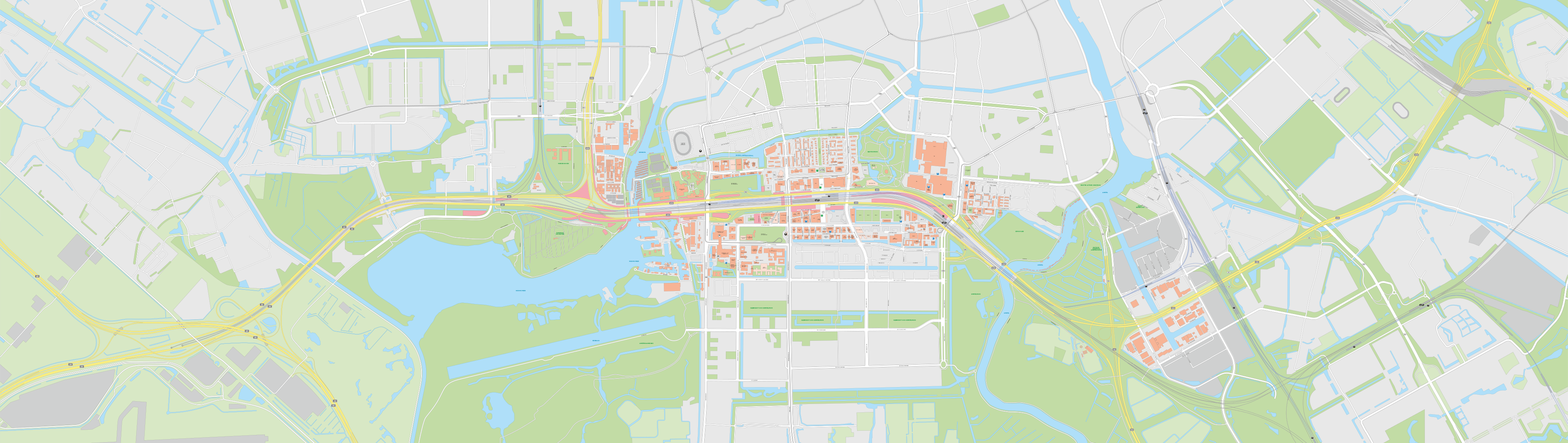
We take a seat on some couches between the works of two major Dutch contemporary artists. They are by the painter Robert Zandvliet and conceptual artist Guido van de Werve. The Art Space is full of nooks and crannies like this. ‘Setting up this kind of Art Space in the expensive office accommodation in Zuidas was a point of contention’, explains Alberdingk Thijm. ‘But it was a firm condition set by the City of Amsterdam that the plinth of the building should be made public and preferably given a cultural use. We wanted art, but were also eager to make it a permanent feature of the building. And that idea also had to reflect the identity of the company. We’re now seeing mothers coming here from Beatrixpark to drink coffee in the mornings and visitors from local companies taking a look around in the afternoons. Occasionally there are even boards of directors and school parties here at the same time.’
Gradually growing collection
The AkzoNobel Art Foundation was first established in 1996. It was the brainchild of the then Chairman of the Management Board, Kees van Lede. At the same time, a non-profit foundation was also set up to enable the collection to grow gradually. Asked whether this kind of art collection is actually a little elitist, Alberdingk Thijm responds without hesitation. ‘Look, art is more than decoration and window-dressing. So, you need to do more than just put it on display. It needs to be dynamic, ask questions, provoke debate. And you also need to be ethical in your approach. The annual budget is very modest, but the collection is now extremely valuable. But we would never sell anything from the core collection. For AkzoNobel, it’s become an incredibly effective PR tool. This is high-quality art that has proved its sustainability. Just like investing in people through the medium of art is also very sustainable.’
Shared world
This idea is also encapsulated in the title of the current exhibition Common Ground. Alberdingk Thijm believes that common ground is something very much needed, because it is increasingly disappearing. She puts this down to the far-reaching digitisation, the decline in physical contact and the fact that the world is always on the go, influenced by our ever-increasing mobility. For her, it is about a shared world, about the sun that shines on all of us and the grandeur of nature that we all share with each other. The opening canvas in the exhibition, by artist Joris Geurts, is testament to this, as is ‘Tools for feelings’ by Maria Roosen. According to Alberdingk Thijm, Common Ground is also reflective of AkzoNobel itself, a multinational with a turnover of €9.3 billion in more than 80 countries that also has colour – ‘Passion for Paint’ – as an important theme.
Art network
For years, Alberdingk Thijm has been selecting talented young artists with works that reflect the current age. They also need to bring together the world of business and art, without it becoming too literal. This approach has resulted in a carefully-accumulated collection of 1,800 artworks, many of which are regularly loaned out to international museums. ‘I operate within a large art network. I think the current collection is a reflection of contemporary art and that our collection is accessible for people across all parts of society.’ Before the summer, Alberdingk Thijm plans to set up a Common Ground part 2. It is her contribution to the cultural climate in Zuidas. ‘That’s something that still has an awful lot of potential.’
More information
The Art Space is open to the public on working days from 10.00-17.00 and by appointment. The address is Christian Neefestraat 2, 1077 WW Amsterdam. Find out more on the AkzoNobel Art Foundation website.
Share article:
Give your opinion
Get in touch with us