
The Amsterdam soil is made up of multiple layers. This includes in Zuidas, with a layer of clay and peat just below street level and several layers of sand from a depth of around 12 m below sea level. These layers differ in terms of composition and solidity and the groundwater level is also an important factor. All of this can make quite a difference if you plan to build houses and offices on that soil. Even more so if you are planning to build a kilometre-long tunnel (the A10 tunnel) actually in the soil. Starting in August 2025, we are therefore conducting hundreds of ground surveys to assess the situation, so that we can build a tunnel that remains in place next to Amsterdam Zuid station for the rest of the century.
Anchor-pile test
Thanks to Archimedes, we know that the groundwater will exert upward pressure on the A10 tunnel. This is why we are using hundreds of anchor piles to fix the tunnel tubes into the ground. But we also need to know in advance what load-bearing capacity the piles will have. For this purpose, some 20 anchor piles measuring around 30 m in length will be inserted into the ground with a mixture of water and cement (grout) on the end that will harden underground, anchoring the pile in place. We will then use a jack to pull on the anchor pile from above to assess how much force it will take until it gives way. This will give us vital information about the type and number of anchor piles we will need to use.
Anchor piles and open construction pit
The anchor piles are particularly important where we are using the open-pit construction method. In this process, sheet piles are first inserted into the ground in order to excavate the space for the tunnel between them. We fill this with water and apply a layer of underwater concrete before pumping away the water above. This creates an empty pit that is not yet anywhere near heavy enough to counter the upward force, because the concrete tunnel tube is not yet in place to weigh it down. The anchor piles keep the pit in place.
Penetration tests
The mass of the tunnel itself is what will push everything downwards. To find out how we will need to counteract these downward forces, around 400 penetration tests will be needed up to a depth of -40 m below sea level (Normaal Amsterdams Peil (NAP). In these tests, we use a special vehicle to push a probe (referred to as a cone) into the ground, which is a small iron rod fitted with sensors on the end. We use this to measure the resistance and load-bearing capacity of the soil. This enables us to determine what kind of foundation piles will be needed for the tunnel tube – these have to be strong enough to prevent the tunnel tube from sinking into the Amsterdam soil.
Soil borings
Our other surveys will include around 300 soil borings up to a depth of around 30 m. Unlike in the penetration tests, this actually involves bringing pieces of ground samples up to the top, both ‘disturbed’ (loose material) and ‘undisturbed’ (small columns of undisturbed material). These are used in the laboratory to compile an accurate borehole profile, indicating the type (e.g. clay or sand) and colour of the material, the depth at which it was found, its texture and consistency. This information is invaluable in developing the design of the earth-retaining structures. It also helps us to understand the level of contamination and quality of the soil, which will prove necessary if we remove large amounts of soil during construction of the tunnel for later reuse – strict rules and regulations apply for this.
Representative sample
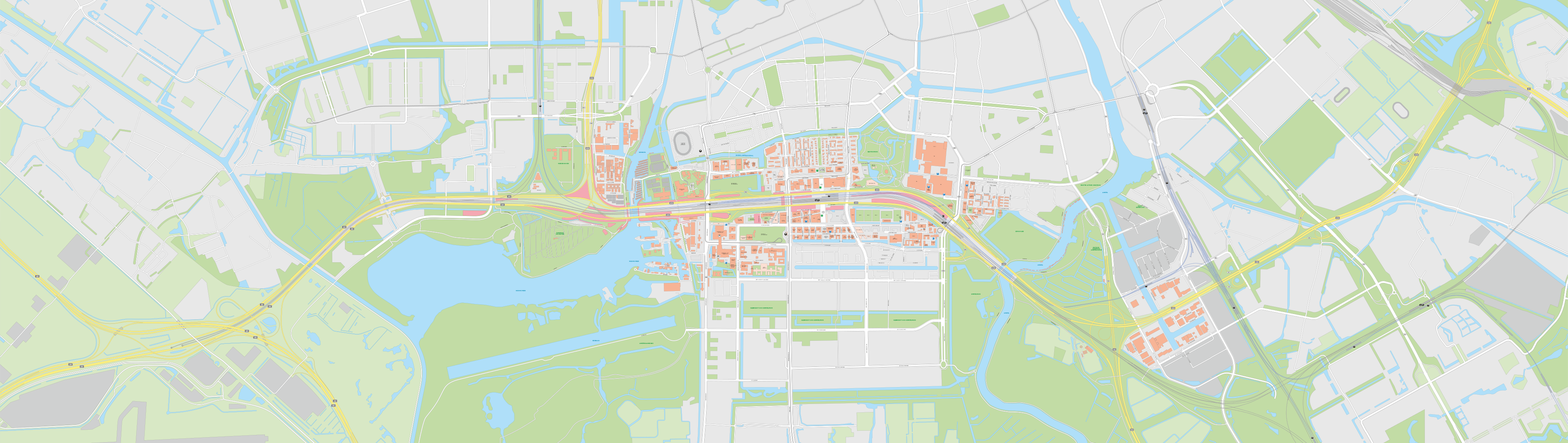
Starting on Monday, 11 August, we will be performing an anchor-pile test with 15 anchor piles on the south side of the A10 Zuid, alongside Spoorslag between Gustav Mahlerplein and Antonio Vivaldistraat. On Friday, 29 August, we will start on the north side of the A10 Zuid close to the New Courthouse, again using 15 anchor piles. The soil borings and penetration tests will be at the same two sites. The number of sites will later be significantly increased, but we first need to know which equipment is best suited for this purpose – ideally as small as possible – in order to limit local disruption. The ground surveys will have been completed by November of this year.
Disruption restricted to Spoorslag only
From Monday, 11 August until November 2025, Spoorslag will be closed to cyclists and pedestrians between Beethovenstraat and Antonio Vivaldistraat (next to EY and EMA). The diversion will be via Maurice Ravellaan. Please note: from 13 October, Ravellaan will be closed from Beethovenstraat. The alternative route for vehicles will be via Vivaldistraat, cyclists and pedestrians can travel around the works. The ground survey at the New Courthouse will start on Friday 29 August and will not cause disruption.
From 18 August until 12 September, Spoorslag will be closed on the other side between Beethovenstraat and Gustav Mahlerplein. We are clearing underground cables and pipelines here to enable construction of the tunnel. The diversion will be via Gustav Mahlerlaan.
Share article:
Give your opinion
Get in touch with us