
They are approx. 14 m in length, more than 3 m wide and around 3 m high. Each of them weighs 160 tonnes, as much as a blue whale, the heaviest animal on the planet. It is therefore no coincidence that these bearer beams will be transported by water from a factory in the Friesian village of Kootstertille. ‘It’s simply not possible by road. Because of their size, we would have to transport the beams individually, but even then certain viaducts would prove difficult because of the weight’, says Martijn van den Ham, planning engineer with the TriAX construction consortium (Besix, Dura Vermeer and Heijmans).
Follow the journey live
Using this link you can follow the bearer beams’ five-day journey by water from Kootstertille to the Schinkel via the webcam on the boat.
Flyover supports
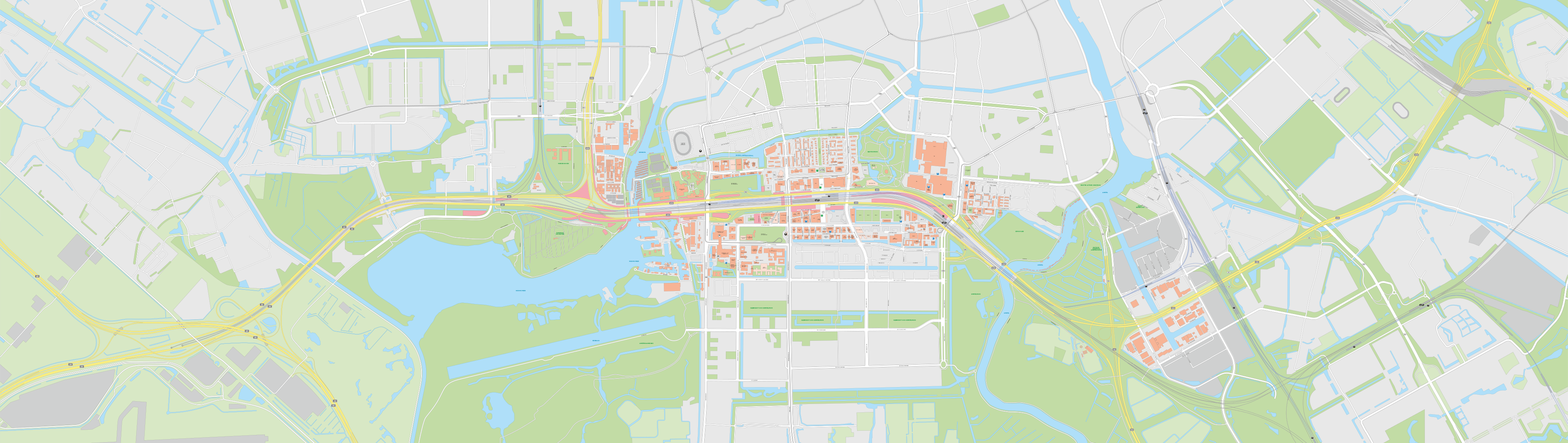
The concrete beams form an essential part of the 300 m long flyover that we are building at the De Nieuwe Meer junction. This will connect the A10 Zuid to the A4 (in the direction of Schiphol/The Hague) and will rest on columns. We will soon be fitting the bearer beams on top of the columns. In the future, they will support the weight of the road surface. ‘Building the beams directly on top of the columns wasn’t an option’, explains Van den Ham. ‘To start with, you’d need to build scaffolding around a column like that. There’s not enough space everywhere, so that would mean closing the A10. And then you’d have to build the entire bearer beam. In such a busy area, that’s just not possible.’
Ikea flatpack
Instead, the bearer beams – of which there are 12 in total – have been pre-built at Haitsma Beton in Friesland. The company has the reinforcement cage (the steel structure in the beam that reinforces the concrete, see photo) prefabricated at another company. A steel mould is then built around this, which is also supplied ready to use. The concrete goes into that mould and when it has hardened, you have a bearer beam. ‘It’s just like putting together an Ikea flatpack, with all those prefab parts’, says Van den Ham. ‘That process takes about a week, so you’re talking around three months to make 12 prefab bearer beams.’
A four-day (roundabout) journey
The bearer beams are being transported in threes. That means that, later in 2025, there will be three more transports by water to bring them all to Amsterdam. ‘The beams in the first transport are the lightest, as you might expect. Later there’ll be three weighing 194 tonnes and even three weighing 204 tonnes.’ In Friesland, the beams are lifted directly onto the pontoon from the factory, in this case on the afternoon of Monday, 22 September. ‘It will then take around four days before they arrive at the Schinkel’, says Van den Ham. ‘The pontoon is too wide to fit past the Schinkelbrug bridge, so the transport will travel via the Amsterdam-Rhine Canal to Utrecht and via Gouda to Amsterdam.’
Landing onshore
Once on our construction site alongside the Schinkel, another challenge awaits: landing the bearer beams onshore. ‘We plan to put a pontoon here around 10 m wide and 60 m in length. From there, we’ll use a special trailer – capable of carrying a very heavy load and pulled by a vehicle – and drive it under a bearer beam. It has jacks in it that lift the trailer slightly higher. When it’s underneath the bearer beam, it’s then driven onshore. That means that we don’t need any cranes.’ This sounds like quite an operation, but how unusual is it actually? Van den Ham: ‘Making a bearer beam is quite common, but almost never prefabricated or this heavy. Lighter beams could be transported by road. Transport by water like this is highly unusual.’
Fitting the bearer beams
All of the bearer beams will be driven to our work site in Riekerweg, where they will remain in storage until we fit them above the columns. The first two beams will be done as soon as 14 October. ‘There’ll be no need to close the road. This will give us time to practise the process and see what it all involves’, says Van den Ham. Later this year, we will fit three further bearer beams during (weekend) closures. Of course, we will keep you updated on this. A further four beams will be fitted in 2026. The last three bearer beams are for the new flyover on the south side (which connects the A4 to the A10 Zuid A1 Hengelo/A2 Utrecht) and will not be fitted until 2028.
Widening of A10 Zuid
The flyover is part of the reconstruction of the De Nieuwe Meer junction that is needed in order to widen the A10 Zuid by adding two additional lanes for local traffic. In the future, traffic will either leave the city from the S108/Amstelveenseweg or take the S109/Europaboulevard to reach the new parallel carriageway. Drivers will then be able to take the new flyover from the De Nieuwe Meer junction to reach the A4 Schiphol/Rotterdam.
Share article:
Give your opinion
Get in touch with us