
Even if your eyes are completely focused on the road, it is difficult to miss: a huge pile of sand alongside the A4 at the De Nieuwe Meer junction, in the final kilometre leading to the Schinkelbrug bridge. It has an important role to play in the regeneration of the A10 Zuid. In the future, this section of the orbital ring road will have two additional lanes in each direction of travel, intended for local traffic travelling from and to the exits in the direction of Amsterdam Zuid. This pile of sand is destined to play a leading role.
Bypass
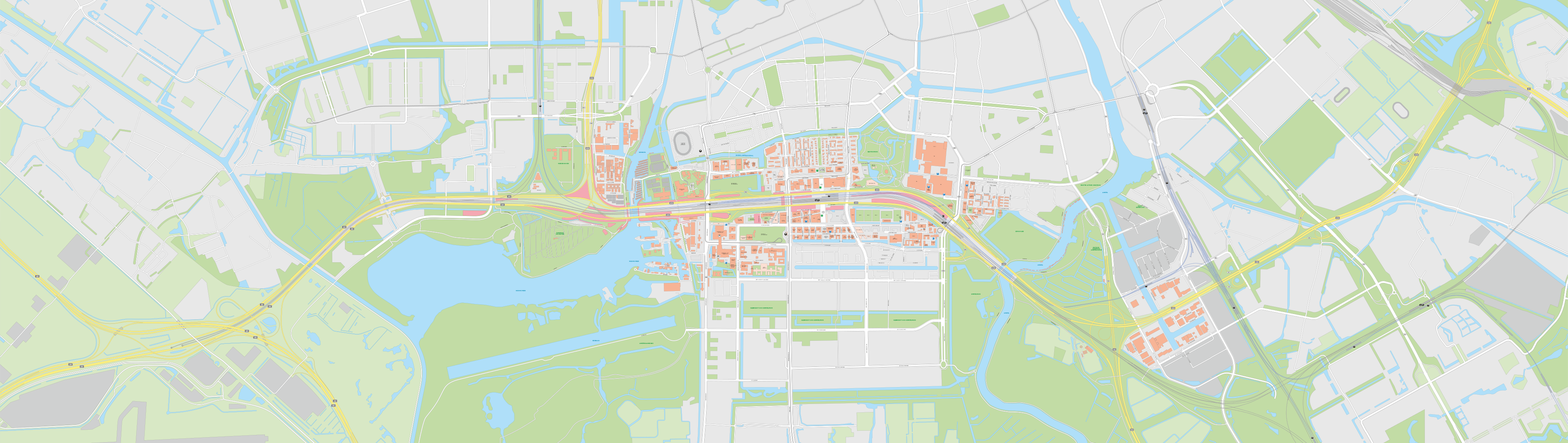
On top of this 800 m long embankment – some of our builders call it the ‘Dutch mountain’– is where the two lanes for traffic heading in the direction of the S108/Amsterdam Oud Zuid will ultimately be. However, between mid-2027 and 2031, there will be a temporary diversion route on it for all traffic travelling from the direction of Schiphol and the A10 West to the Schinkelbrug bridge and the A10 Zuid. We will then use the new road as a ‘bypass’. This is necessary because we need to demolish the existing road bridge across the river Schinkel (bridge 10, see the map below) in order to build two in its place (bridges 7 and 8). This means that the third bridge we are building (bridge 9) – which will be used for local traffic after 2031 – is actually being built first but used initially as a bypass. This is absolutely necessary, because 120,000 road users drive from the A4 in the direction of the A10 Zuid every day.
Making changes to the A4
Back to that pile of sand. It is currently towering 6 m above the adjacent A4. The total weight is huge and that is exactly what is intended. In the years ahead, this ‘mountain’ will compress the ground underneath it – around 20 to 30 cm in half a year. This will result in a solid substrate on which to build the extra lanes. We will soon be levelling the pile of sand to around the same height as the A4. After that, we will lay three lanes of asphalt on it that will be used to divert traffic during the works on the A4.
Viaduct too narrow
But the job will still not yet be complete. Next to the Ons Buiten garden park, we need to demolish the existing A4 viaduct and build a new one. This viaduct, underneath which the traffic travelling from the A4 to the A10 West runs, there are currently two lanes and a rush-hour lane. In the future, it is at this viaduct that traffic will have to opt for the route for through-traffic or the one for local traffic. For this reason, there will be four lanes plus a hard shoulder on it: two for through-traffic and two lanes for local traffic. We need to demolish this viaduct and build a new one, because it is not suitable for widening.
The new viaduct will be five lanes wide, making it wider than the parallel lane. This means that, during the diversion, we will have a section of viaduct ‘left over’. This will be needed later when we move the viaduct to its permanent position on the A4 (see below), with space for both through-traffic and local traffic.
New viaduct
For this work, the A10 Zuid still needs to remain accessible during the construction of a new viaduct. This is why we are first building a completely new and wider viaduct next to the existing one. We will begin using the new viaduct in mid-2027, as part of the diversion route over the new parallel lane. We will then be able to demolish the old viaduct. By 2031, the regeneration of the De Nieuwe Meer junction will be more or less complete. We will then move the viaduct towards the location where the old viaduct now is. The new parallel lane will then merge, as it were, with the modified A4. From then on, the bypass will change into a parallel lane for traffic heading for Amsterdam Zuid.
Share article:
Give your opinion
Get in touch with us