
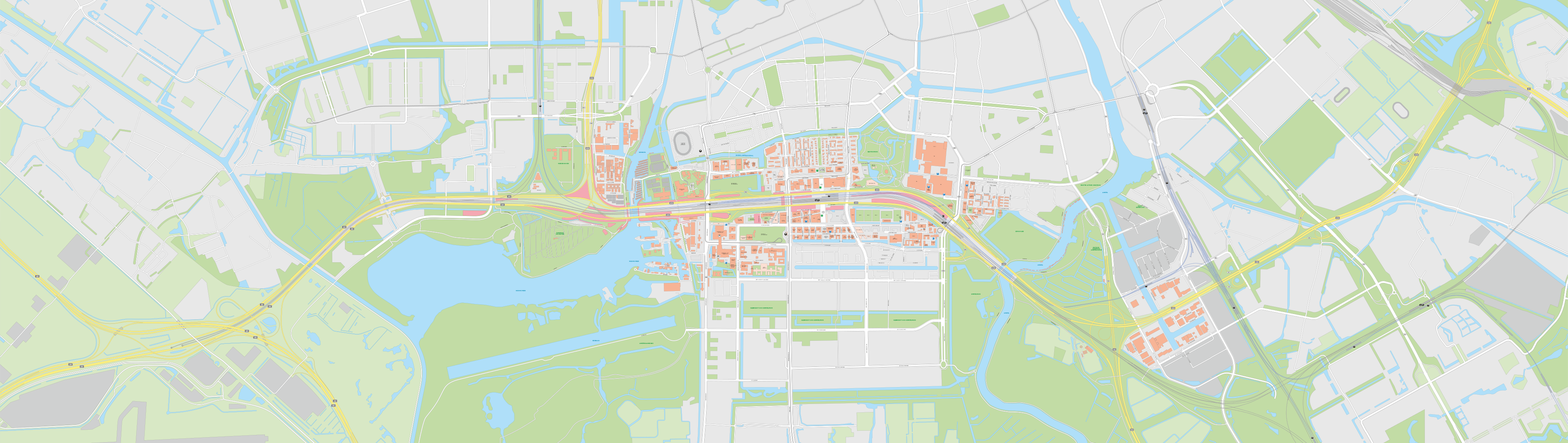
As we walk from Van der Boechorststraat into the spacious and mostly glass atrium, we need to watch where we are going – this is actually the entrance to two buildings. If you turn right, you enter the Amsterdam UMC Imaging Center, but we need to head left to take a look at the recently completed Research & Diagnostic Centre Adore (RDC ADORE). We are welcomed by Marianne van der Bent, project manager at Amsterdam UMC: ‘The atrium is quite an eye-catcher, isn’t it?’ This is certainly the case, but more about that later.
Cross-fertilisation
Van der Bent waves her staff pass across the scanner and leads us to RDC ADORE: ‘On October 1, the MedicomZes/Kuijpers contracting consortium completed the building, exactly on schedule.’ From December, the first cancer and brain specialists will begin to arrive and the full complement of staff will be in place by the second quarter of 2025. By then, the laboratory diagnostics departments in the fields of Pathology and Human Genetics will also have moved into the building. Van der Bent: ‘The building has been specifically intended to be a place where researchers from both disciplines can learn from each other, collaborating with their colleagues in the diagnostic laboratories to develop new diagnostic and innovative treatments.’
Cancer Center Amsterdam
Some of the staff at RDC ADORE come from the Cancer Center Amsterdam. This distinctive building with its blue and red blocks next to the A10 Zuid served as temporary accommodation for oncologists and staff until the new building on the south side of Amsterdam UMC was completed: RDC ADORE and the Amsterdam UMC Imaging Center.
Inner courtyard
A staff pass is not needed for every room: via a staircase at the entrance, we can reach two of the six floors without hindrance. Van der Bent: ‘The conference room is here, which can also be used by external researchers and the public.’ We suddenly find ourselves face-to-face with a huge spiral staircase, at the centre of a tall space bathed in sunlight through the glass roof. ‘The different floors can be accessed by lift, but are also connected to each other via this spiral staircase at the heart of the building’, explains Van der Bent. ‘That’s why this area, which will later be fitted out with furniture and a coffee bar, will be the natural place for all the researchers in the building to meet.’
Light and airy and sustainable
‘The organic shape of the spiral staircase contrasts with the straight lines in the structure of the building’, explains Martijn de Visser from the architect firm Atelier PRO by telephone. ‘The building is also quite deep, which means that daylight cannot easily penetrate the heart of the building. That’s why the glass roof is there.’ This focus on light is also reflected in the pastel shades used in the office areas, as well as in the choice of materials. For example, De Visser tells us that the façade is mostly made of concrete reinforced with glass fibre, a lightweight material: ‘That ensures a smaller CO2 footprint. In addition, the building also gets its heat from an energy-efficient thermal energy storage system and RDC ADORE is the Netherlands’ first building to boast low-carbonglass.’
Back in the atrium
After the guided tour, we take another good look around the atrium, which also serves as the crossing to the Zuidas Botanical Garden and Amstelveenseweg. This is a large, calming space, with a lot of glass and plenty of natural daylight. It also features a stunning mosaic floor and pink-coloured seats that double up as planters.
But there is no reception and no desk – nothing refers to the care and medical research that is happening on both sides of the atrium. And, as we hear from architect Henk Hartzema from Studio Hartzema, this is exactly the intention: ‘Don’t forget, this can be quite a tense place for some people. Think of the Amsterdam UMC patients who come here for a diagnosis or a test result. For them, we hope that the atrium will be somewhere where they can feel human again.’
Share article:
Give your opinion
Get in touch with us