
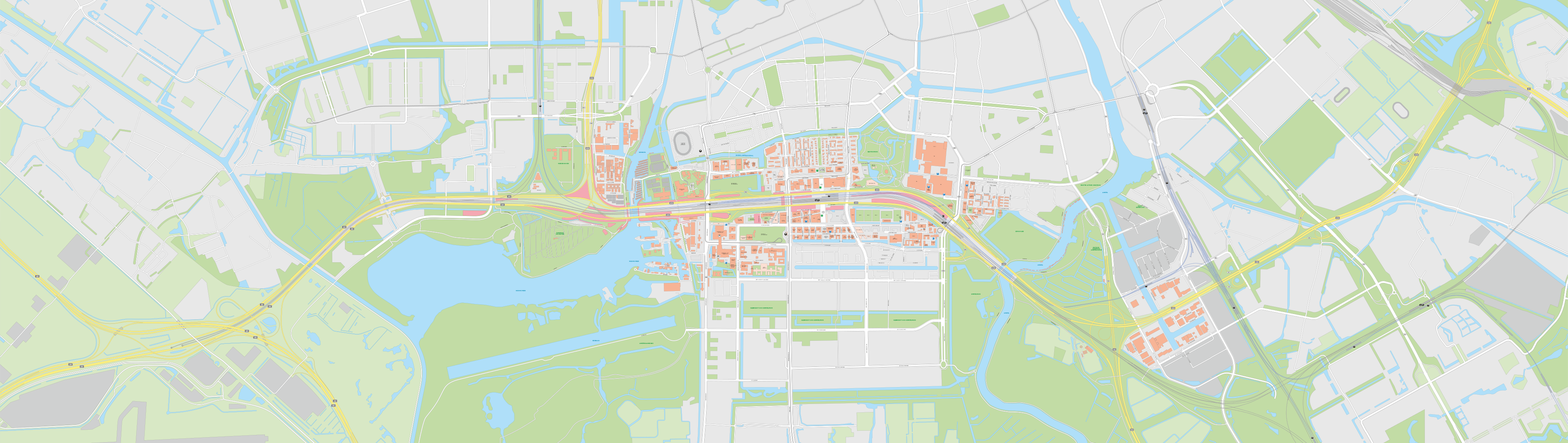
Work is now underway at various different locations around the De Nieuwe Meer junction. Cranes are being erected to install sheet piling. Diggers are removing the embankment in various places and all kinds of things are happening around the Nieuwe Meersluis lock, next to the Schinkelbrug bridge. The dozens of people working there know exactly what they need to do and in what order. This may seem obvious, but it is far from it. ‘It’s an extremely complicated project. The work supervisors know what needs to happen from day to day because we know exactly how we need to plan and schedule the works. It involves an awful lot of preparation, says Eric Engelhart from the TriAX construction consortium (Besix, Dura Vermeer, Heijmans). He specialises in visually combining design and planning: 4D planning. ‘4D planning is essentially about building the project digitally first. If we come across works that clash with each other, we can resolve the problem before actually doing it outdoors. 4D makes everything easier on the ground: safe, efficient and within a tight schedule.’
Removing bottlenecks
Any construction project starts on the drawing board, with a design and a schedule. This is often followed by a three-dimensional design to provide a good impression of what it will look like in reality. ‘For the De Nieuwe Meer junction project, these three elements have been combined in a process of 4D planning. This starts at the very outset, during the tender procedure. It’s pretty unique. It’s enabled us to remove all kinds of bottlenecks at an early stage.’

Solving the puzzle together
‘Linking the 3D design of the project to the overall planning process enables us to visualise every stage’, says Engelhart. ‘The result is like a film that shows how the design will be executed over time. It can cover the entire project or possibly just the work at a specific location during one particular weekend. The work on the 4D plans involves multiple disciplines: including specialists in foundation work, cables and pipelines, traffic systems as well as road builders and so on. They all have their own specific perspectives, but we need to do the work together. 4D planning reveals the bottlenecks and everyone works together to solve the puzzle of how it can all be accomplished. That way, even before you start the outdoor work, you have an achievable strategy that enjoys everyone’s support.’
View an example of 4D planning

Involving stakeholders in the process
Another advantage of 4D planning is that it makes it easier to explain the construction process to local residents or the managers of systems or buildings, says Engelhart. ‘Technical drawings don’t make much sense to laypeople. And that certainly applies to plans, which in the case of the reconstruction of the De Nieuwe Meer junction includes thousands of rules. There’s no better way of ensuring a good understanding of what we do and why than showing people who live and work nearby why we are adopting this approach to construction. We literally take them through the different steps in the process and what their significance is.’
Take a look from the Tripolis office building

Detailed visualisation
There is yet another advantage when it comes to execution, says Engelhart. ‘At the locations where we’re working at the moment, it really is all about the details: where exactly are the cranes, how big are the safety zones, what route do the access roads take, where are there trees, where’s the construction hut? We visualise this on the day and often down to the hour. That makes it easier for the work supervisors to show the workers on the site, who are often international, how the location fits together, what the safety risks are and how we’ll need to work. That way, the French crane driver understands it straight away. We take the 4D plans of the project as a whole and apply them in detail to the work of a single construction worker on a single day. There’s something almost magical about it.’
Franklin Thole, planning engineer at TriAX
‘I plan virtually everything in 4D. I organise sessions with people working on preparations, planning and execution. Take the weekend of 4 to 7 October, when the A10 Zuid was closed in the direction of Schiphol/Rotterdam. Beforehand, we put the whole work site for that weekend in 4D. We then looked at how we could install the sheet piling or whether we were able to do the groundwork as planned, the extent to which our digging up of the embankment might be affected by the A10 itself and so on. All this preparation really helped ensure that we were able to do everything we planned according to schedule.
‘The S108 access road will ultimately run alongside the Tripolis-Park office building. The 4D animation of it is not yet fully detailed, but already clear enough to the users of the office building. If we use the animation to show them that there will be huge pile-drivers right next to the building, it immediately becomes clear that they’ll be better off working somewhere else temporarily for safety reasons. 4D can be very persuasive indeed. And certainly better than having to resort to drawings and charts to explain it.’
Share article:
Give your opinion
Get in touch with us