
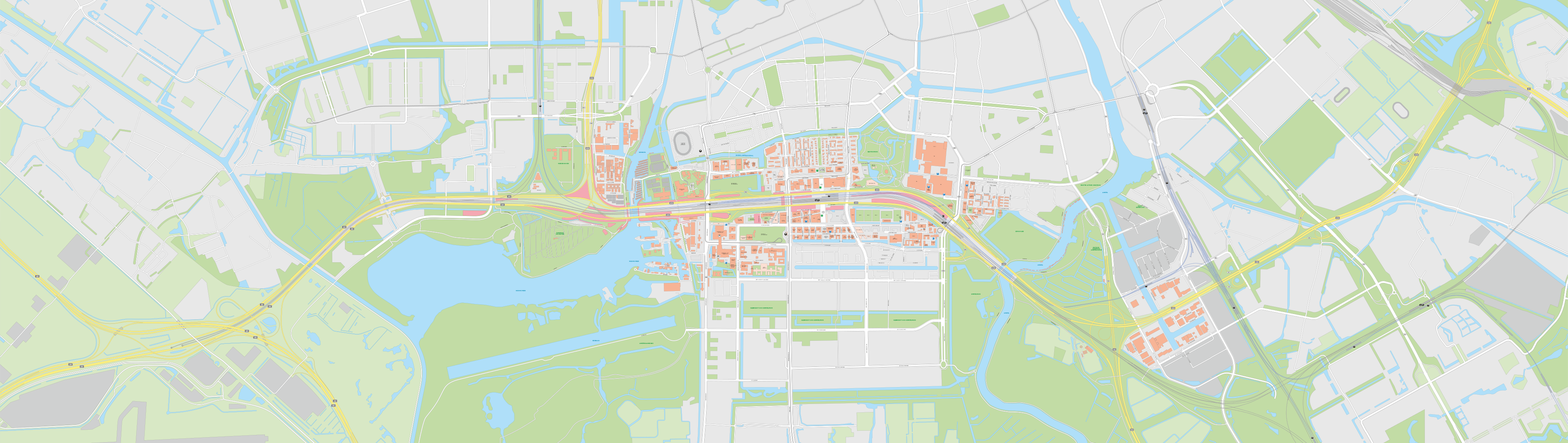
On Wednesday, 12 February, more than 100 people with an interest came along to see and listen to Zuidasdok’s plans for the regeneration of the Amstel junction, which connects the A10 Zuid, the A10 Oost and the A2 to each other. Various maps were on display to show what is set to change and, thanks to an animation (soon to be posted on this website), visitors could see for themselves what the new junction will look like for drivers. Overall, the event proved a perfect opportunity to update you all. So what areas were covered?
Local traffic
Between the Amstel and De Nieuwe Meer junctions, we plan to widen the A10 Zuid with two extra carriageways for local traffic in both directions. We are separating traffic travelling to and from the city from through-traffic travelling past the south side of the city – this will be safer and improve traffic flow. It requires changes to be made to both junctions, i.e. the Amstel junction and the De Nieuwe Meer junction.
Measures to combat noise
Additional carriageways inevitably cause noise disruption to the local area. We are therefore conducting monitoring at a range of reference points along the A10 in order to ensure that noise is not exceeding the permitted levels. This has resulted in various measures, such as the use of silent asphalt on the A10 Zuid: ‘dual layer porous concrete’ (zeer open asfaltbeton). In specific locations, we are even using an even more effective type of porous concrete (2L-ZOAB fijn). In addition, we are positioning noise barriers measuring 1 to 2 m in height next to the A10. There will also be noise barriers between the main and parallel carriageways, up to 7 m in height. As a general rule, the closer a barrier is to the source of noise, the more effective it is at reducing it.
Footpath and cycle paths
We are also making changes to the local road network in various places. This includes the laying of a footpath (see map 1 below) leading from Amsteldijk, and past Amstelpark, to Europaboulevard. Halfway along it, the new cycle path will connect to a cycle path across the river Amstel, enabling cyclists to cross the Amstel from the Amsteldijk directly rather than having to cycle around it. Currently, the cycle path across the Amstel still goes over the southern Rozenoordbrug bridge. However, this is being moved to the bridge that we are building for the parallel carriageway, including a brand-new footpath across the Amstel (see map 2). And at Ouderkerkerdijk, to the east of the river Amstel, we are merging the road and cycle path to create a cycle street, where bikes have priority and cars are ‘guests only’ (see map 3).
Below, you can see the current situation at the Rozenoordbrug, with the new connections added (red dotted lines). Other changes, such as the new southern Rozenoordbrug are not shown here.
Green spaces
The Amstel junction is located in a green environment very uncharacteristic of Amsterdam, where the river Amstel and the Amstelglorie community garden are both located. In our plans, we are making every possible effort to ensure that as much of the green space as possible will ultimately be reinstated. However, local residents and nature lovers will need to be patient: at the time of (re)planting, the trees and plants will not yet be fully grown and will take time to reach maturity.
Schedule
The tender procedure for the Amstel junction project was launched on 8 November 2024 with an announcement posted on TenderNed. A contractor for the project will be selected by the end of 2025. This will be followed by a design and preparation phase. Construction is expected to start in 2027.
Missed the meeting?
If so, register for our newsletter. You will then receive all articles and announcements of information meetings in your inbox. You can even indicate what you wish to receive reports about and how often. You can register for the newsletter here.
Share article:
Give your opinion
Get in touch with us