
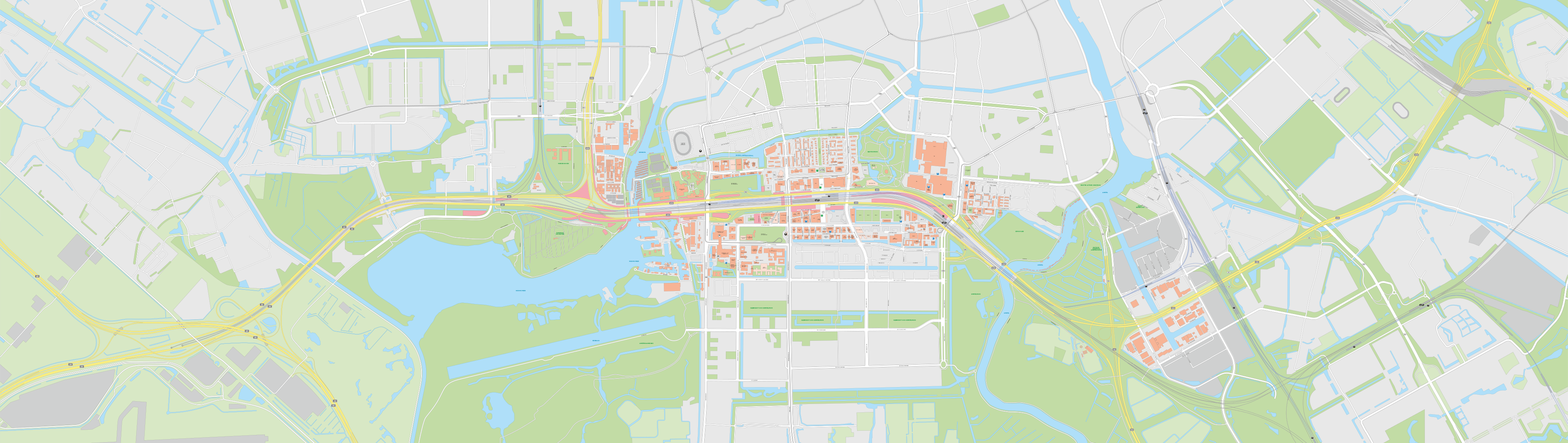
A new residential district is emerging on the area of sand to the south of Maurice Ravellaan, which opened this year. The site is currently a combination of sand, fencing, material, and containers. Recently, though, the contours of the Ravelly residential tower block have started to take shape near the new Kindercampus Zuidas. This first residential tower block in the new residential district of Ravel, where the use of motor vehicles will be significantly restricted, will soon be home to 75 social rental dwellings; on the ground floor – the ‘plinth’ – there will be room for a nursery. It was the construction of this plinth in particular that was so time consuming. But contractors SBB have now reached the fifth floor, with another three to go.
Take a look at the new residential district (you could be living here one day!)
Around 1,350 family homes are to be created in the Ravel residential neighbourhood. Of these, 40 percent will be social rental housing and 40 percent mid-sector rental homes. What will it look like? Come to the observation post during Zuidas FutureFest (ToekomstTiendaagse) and get up to date on the latest developments. With the help of 3D images, you will get a good idea of what Ravel will eventually look like. Who knows, you could be looking at your future car-free neighbourhood!
- On work days from 12 June to 19 June, between 10:00 and 15:30, and on Saturday 14 June from 10:00 to 13:00.
- Access: the corner of Beethovenstraat and Maurice Ravellaan | Amsterdam
- Participation is free of charge
Trapezium column
‘The plinth has concrete columns in the form of inverted triangles. We call them trapezium columns.’ While talking, Marcel Evers, the head foreman at contractors SBB, moves across the building site towards Ravelly’s future main entrance. As he arrives at one of the trapezium columns, he points from the ceiling to the floor. ‘We poured them on site. As you can see, the column at the base is a good deal narrower because of its triangular shape, and that is despite the fact that the column is quite sizeable. We built the formwork ourselves, although we had to think long and hard about how we could do that. Concrete is heavy, so how do you ensure that the formwork remains in place and the base supports the weight? It all came together in the end and now looks really smart.’
Green colouring agent and kitchen cupboard system
Other concrete elements have been attached to the plinth columns – as is the case with the rest of the front of the building. They are slightly greenish. ‘These are prefab building-front elements, so they are a lot less complicated’, laughs Evers. ‘During the manufacturing process, the concrete was mixed with a colouring agent, and that produces this greenish colour. That means it won’t be washing off.’ The elements are delivered ready-made to the building site and are then hung onto the outdoor concrete front. ‘That is done using a kind of click system. We attach steel brackets, or types of hooks, to the façade elements. We create steel bulges on the façade itself, in which these hooks fit precisely. It is just like a kitchen cupboard system – you simply hang them up.’
Building shell and front rising in tandem
Remarkably, a large proportion of the façade elements have already been ‘hung up’, and the window frames and windows have already been installed on Ravelly’s lower floors. ‘You would think that we work on the shell of the building all the way to the top first, followed by the façade’, says Evers. ‘But because we use the prefab façade elements I mentioned, we decided to start constructing the façade at the same time. After all, you don’t want to be hoisting the elements upwards alongside the building at a later stage, as that would endanger safety and would not really be feasible. Work on the façade is about two storeys behind that of the work on the shell of the building. Installing the windows is also part of this process – and that means it is all proceeding at a rapid pace. The façade will be more or less closed completely by the end of the year.’
Dismantling to start after the summer
Things are moving at pace on the interior too – prefab stairs linking the floors have been fitted, for example, and walls separating the individual homes have also been erected. ‘The homes have surface areas of 45 or 73 square metres’, explains Evers. ‘They will all have outdoor spaces and will all be delivered with kitchen units and sanitary fittings.’ It is still difficult to imagine what the end-product will look like, but Evers assures us that that too will change very quickly. ‘We will start the process of dismantling all the construction paraphernalia after the summer. We will then fit the interior walls and the screeds. The pipes and cables will be fitted, and the plasterers will be coming. The first homes will be ready before you know it.’
An ocean of space
A short time later, we find ourselves on the fifth floor, from where we have clear and sweeping views of De Boelelaan and Beethovenstraat. Looking towards the north, we can see the imposing Valley and the AFC football pitches. ‘It is very special here’, says Evers. ‘Everyone in Zuidas talks about working in a space the size of a postage stamp, but because we are the first residential building project in Ravel, we have oceans of space. Where else in Amsterdam could you still build in the centre of such a large sand pit? I think it’s amazing.’
The timetable and the parties
Ravelly will have 75 social rental homes, which are expected to be ready in the third quarter of 2026. Of these, 29 will have a usable area of 73 square metres, suitable for small families. The other apartments will be 45 square metres in area. A nursery will be established on the bottom floor of the building (the plinth), which will form part of the Kindercampus Zuidas. Elsewhere on the ground floor will be a cycle storage facility for the residents. Once the dwellings have been completed, they will be made available via WoningNet. The commissioning party is Woningstichting Rochdale and the design is by Korth Tielens Architecten.
Share article:
Give your opinion
Get in touch with us