
830,000 cubic metres of earth: it is enough to fill approximately 330 Olympic swimming pools. This is how much earth is being removed in order to build the tunnel for the A10 Zuid, on which work will start in 2027. Of course, it will not all be removed at once, but gradually over a three-year period. We also intend to transport it away as efficiently as possible, without causing too much disruption to the local area or to construction work. ‘As part of the design phase for the tunnel, we’re investigating two methods: pumping the earth away by means of a system of underground pipelines or transporting it using trucks. Both methods have their pros and cons’, explains Ton van der Steen, project manager for contractor VolkerWessels.
Pumping it away with water
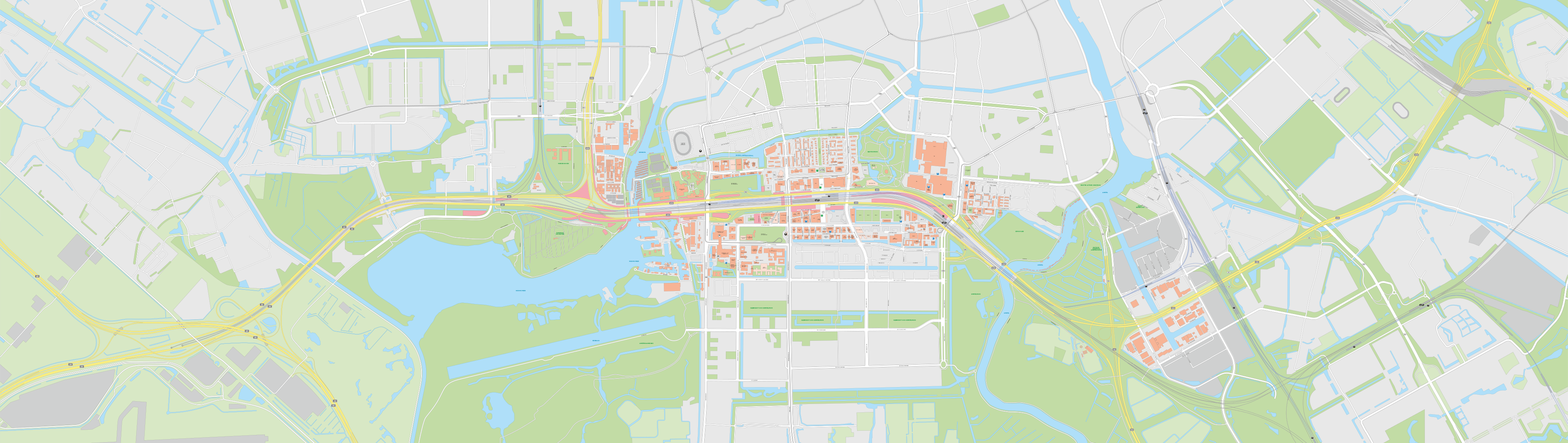
According to Van der Steen, the option of removing the earth for the tunnel construction by means of hydraulic pumping has been explored in some detail. It is a method where you pump in water via a pipeline and then mix that water with the earth. This creates a mud-like substance that can be pumped away via a different pipeline. ‘Of course, that’s a great solution from a logistical perspective as it reduces disruption to the road network and the construction site. But there are also downsides. We’ve explored the option of pumping it all the way to the Nieuwe Meer lake. That would involve laying pipelines across a large area for a period of several years. We would then clash with other Zuidasdok projects, such as the extension work on the Schinkelbrug bridge and the widening of the A10-Zuid.’
Transport by boat
There is a further complication with the lake. Disposing of so much earth in the water there would end up making the water shallower. That could have negative consequences for the water system. ‘That’s why we explored a third option. Using a pipeline system to pump the earth removed for the tunnel construction to the Nieuwe Meer and then loading it onto boats’, says Van der Steen. ‘But those boats would then need to travel through Amsterdam in the direction of the river IJ, passing ten bridges en route that would need to be opened and closed. So, you’re avoiding disruption at the construction site only to move it somewhere else. That would seem pretty pointless.’
50,000 trucks
Transporting the earth by truck would therefore appear to be the more realistic option. ‘Compared to removal by boat, using trucks gives you quite a bit more flexibility’, says Van der Steen. ‘A boat can’t just sail in a different direction, but a truck can opt for an alternative route. Upscaling is easier if it proves necessary and it is also financially more attractive than hydraulic pumping. Of course, there are also disadvantages – don’t forget: you’d need 55,000 trucks to transport 830,000 cubic metres of earth. All of those trucks would have to travel by road.’
Raising the height of Buiteneiland
In addition to the transport, there is also the issue of what to do with all that earth. The current plan is to use some of it – if it is clean – for the construction of the last island in IJburg: Buiteneiland. This island will be about the same size as Vondelpark, with space for sport, nature and leisure, and is likely to be completed sometime between 2045 and 2050. Van der Steen: ‘A dike has already been laid around the future island, but more earth is still needed to fill it and raise the height of the island. Of course, it would be really great if the earth from the tunnel could be put to good use in a circular way.’
This is the seventh in a series about the design of the tunnel in the A10 Zuid and about the techniques and challenges involved. The first was about preparations behind the scenes, the second looked at the lack of space for construction of the tunnel, the third article was about moving the A10 Zuid, article 4 focused on keeping Amsterdam Zuid station accessible during construction, article 5 explored earth-retention techniques and article 6 was about technical installations.
Share article:
Give your opinion
Get in touch with usFrom my understanding of this story. the project team had seriously considered disposing the earth into the Nieuwe Meer..!!?? And the main reason not to, was that it would make the water shallower.. Had this become a reality; you would certainly see a huge backlash from the community and environmental groups. Bizarre that this was even thought about.
That's a misconception. In this article, we do try to highlight the various methods we're exploring during the design phase. Of course, we don't just dispose into the Nieuwe Meer, and not just because we would never get permission to do so.