
Update Wednesday, April 29, 5:00 PM Friday, May 1, is a favorable moment to place the bridge deck. For this, the connection from the A10 West to the A10 South will be closed from Friday, May 1, 7:30 PM, to Saturday, May 2, 5:00 AM.
Update Tuesday, April 28, 2:30 PMThe bridge deck will be in the Nieuwe Meer as planned on Wednesday, April 29. However, due to expected (strong) wind gusts, we are postponing the placement to a more favorable moment. We will keep you informed.
The component in question is the movable bridge section (also known as the deck or bascule) for the new bridge on the south side of the Schinkelbrug. This bridge is being built by construction consortium TriAX (Besix, Dura Vermeer and Heijmans) and will be put into use from 2027 as a temporary ‘bypass’. By 2031, it will be fully completed, including a cycle path across the Schinkel. But first, we need to transport the bridge deck from builder Solidd Steel Structures in Friesland to the Schinkelbrug.
Follow the transport live
From Friday, 24 April 2026, you can follow the transport via a livestream from the vessel, available on a dedicated webpage with photos and interesting facts (in Dutch). Updates will also be shared regularly via Instagram, LinkedIn and Facebook.
300,000 kilograms of steel
The steel structure weighs approximately 300,000 kilograms. This is partly due to the steel deck plate, the surface on which the A10 Zuid will eventually run. The underside is reinforced with heavy steel profiles welded together in a crosswise grid. The structure consists of 33 longitudinal troughs, with five transverse girders crossing them. Altogether, the bridge deck, comparable in weight to a fully loaded passenger aircraft, is far too large to be transported by road from Sumar (Friesland) to the Schinkelbrug.
Robust design
According to managing director Jan Willem Stob of Solidd, this is the first project to be carried out under the new Rijkswaterstaat guidelines: ‘They place greater emphasis on fatigue resistance, as many existing bridges in the Netherlands no longer achieve their intended lifespan due to increased traffic intensity.’ For example, the deck plate of the new bridge is four millimetres thicker, and some welds consist of three or four layers. The welds used to attach the troughs alone amount to approximately one kilometre in total.
12 bridges
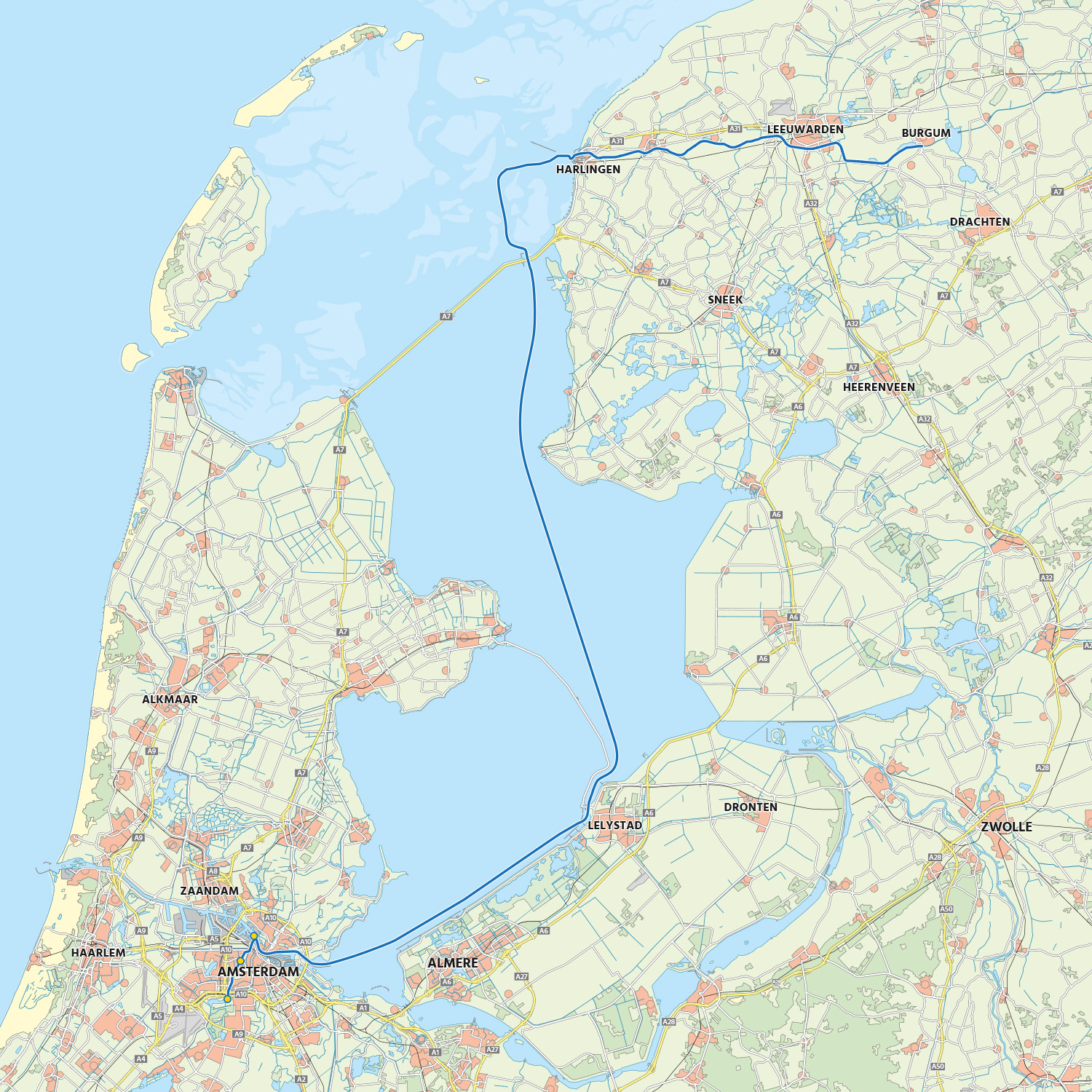
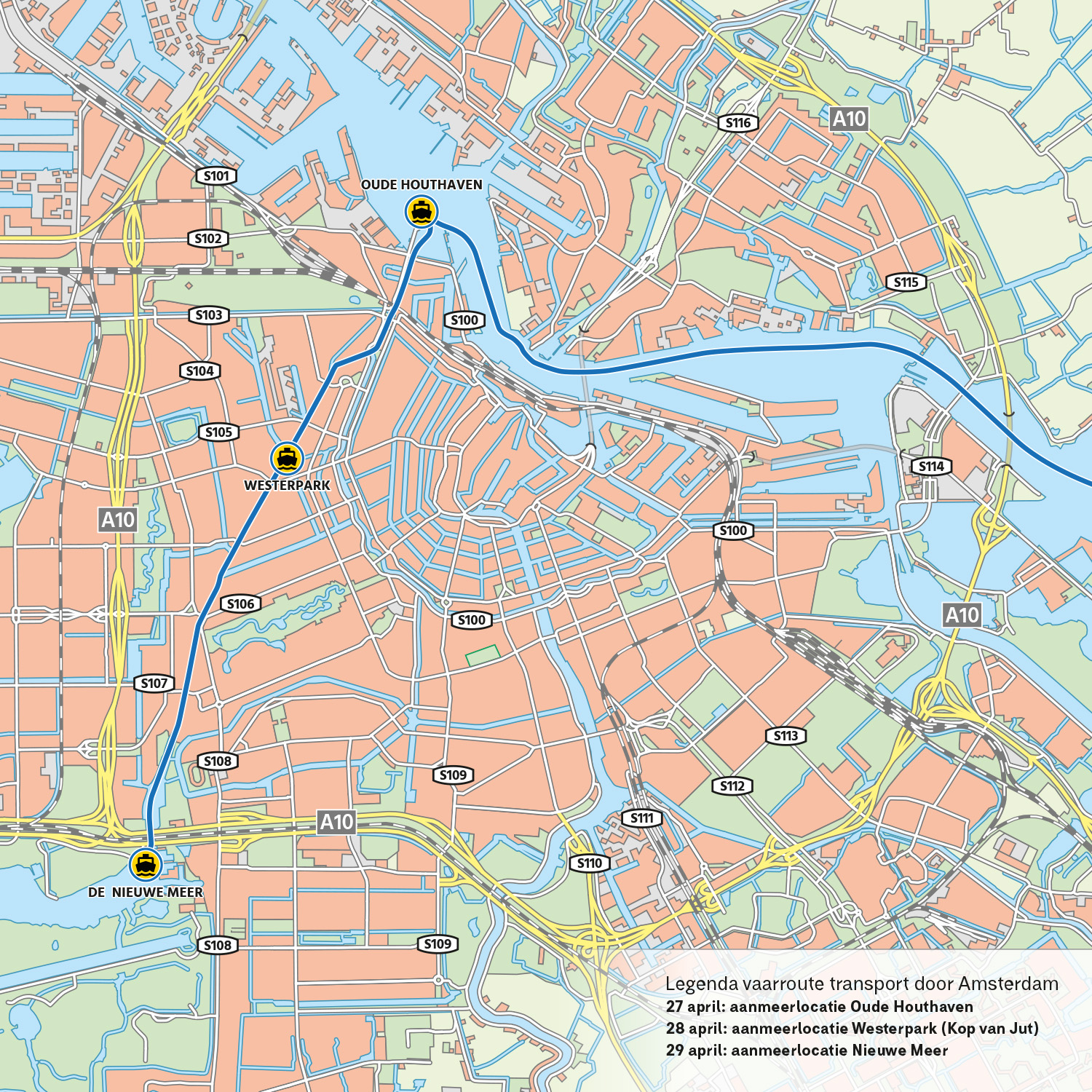
The bridge deck will be loaded onto a vessel on Friday, 24 April. The following day, it will depart from the port of Burgum (near Sumar) and arrive two days later at the Oude Houthaven in Amsterdam. Within Amsterdam, the vessel will pass under 12 bridges, requiring coordination with Waternet and the Public Works Department of the City of Amsterdam (Stadswerken).
Overtoomsesluis bridge
For example, a temporary structural support on the Overtoomsesluis bridge must be removed to allow the vessel to pass. The bridge will therefore temporarily be partially taken out of service. The transport will take place only at night, partly due to busy canals during King’s Day on 27 April. On 28 April after 20.00, the transport will continue from the temporary mooring at ‘Kop van Jut’, via the Kostverlorenvaart, towards De Nieuwe Meer.
Final destination: Schinkelbrug
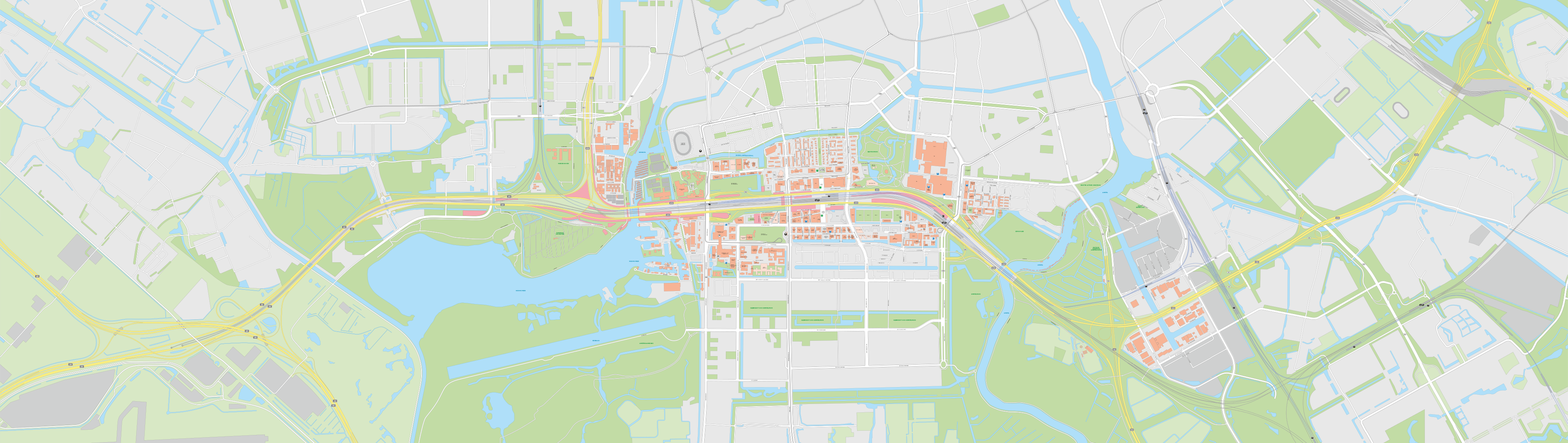
After two nights, the vessel will reach its final destination at the Schinkelbrug. There will be no public event this time, but the spectacular cargo can best be viewed on Monday, 27 April (King’s Day) at the Oude Houthaven or on Tuesday, 28 April at the aforementioned mooring location at ‘Kop van Jut’. On Wednesday, 29 April, the bridge deck will be lifted into place at the Schinkelbrug. This can be viewed from a safe distance near the Watersport Vereniging Amsterdam. Addition April 29: see the updates at the top of this article.
The transport schedule has been planned down to the metre and minute. However, weather conditions – particularly wind – can still affect progress. Bilal Akdeniz, discipline lead for the Schinkelbrug bridges at TriAX, explains: ‘The deck plate measures 26 by 21 metres – roughly the size of two tennis courts – making it too large for Amsterdam’s bridges and locks. We will therefore transport it upright at an angle on a pontoon 11.5 metres wide, but this makes it more susceptible to wind. For safety reasons, we will not sail in wind speeds with a Beaufort scale force greater than 4.’*
*Force 4 on the Beaufort scale corresponds to a moderate wind of 20-28 km/h with longer, visible waves and occasional whitecaps. Updates on the transport can be followed on the dedicated webpage (in Dutch).
Expansion of the Schinkelbrug
In the coming years, the Schinkelbrug will be expanded from five to eight bridges as part of the reconstruction of the De Nieuwe Meer junction and the regeneration of the A10 Zuid. The A10 Zuid will gain two additional lanes in each direction, improving traffic flow and safety. The southernmost bridge (bridge 9) will include a cycle path, allowing cyclists to travel between Zuidas, the Oeverlanden nature reserve and Schiphol in both directions. Later this year, the bridge deck for the northernmost bridge (bridge 1) will also be transported.
Share article:
Give your opinion
Get in touch with us