
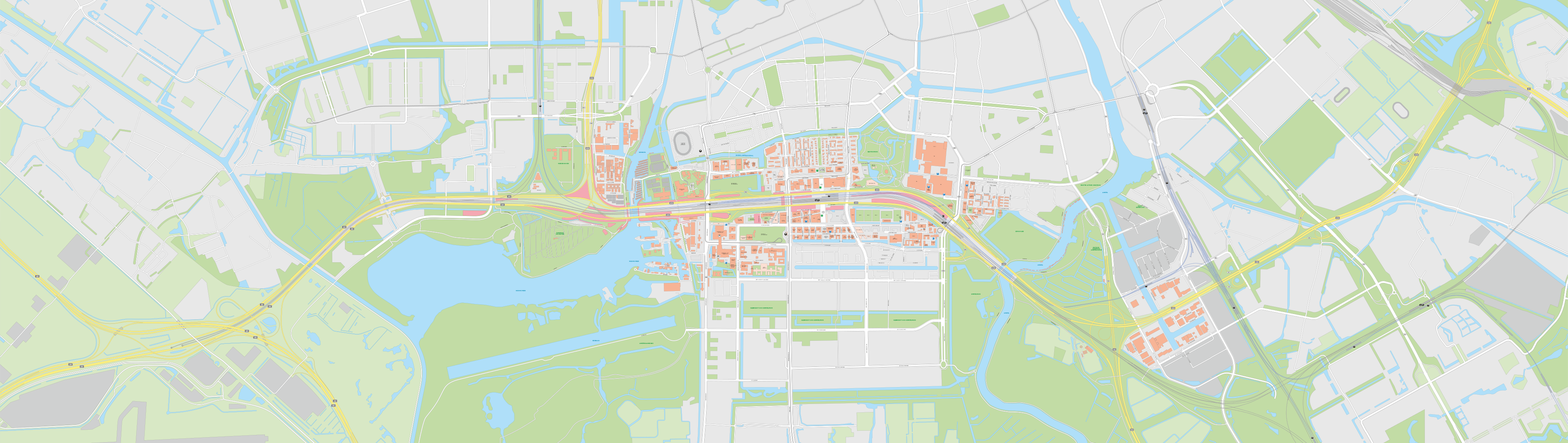
At first glance, the brand-new VU Research Building in De Boelelaan does not look very different from other towers in Zuidas. But appearances can be deceptive. Its secret lies inside, or more accurately: underground. This is because part of the building has been designed to be vibration-free in order to make it possible for high-precision scientific research to be conducted. Experiments using lasers, and electron microscopes, for example. To a layperson, it all sounds very complicated, which is why Paul Goossens is allowing us to see it for ourselves. The head of department in the Housing Office at the VU Amsterdam Science Faculty is showing us around this newly-completed building.
Playful and inviting
‘We’ve spent a decade developing this building’, says Goossens proudly as we walk through the imposing entrance in De Boelelaan via a revolving door. With its concrete walls and black steel staircases, the foyer has an industrial feel, but the natural daylight and natural stone flooring make it look playful and inviting. ‘Completely different from the outdated Mathematics & Physics building on VU Campus, which it was built to replace’, said Goossens. ‘The other building is sixty years old and no longer meets the requirements for research and sustainability. It’s terribly inflexible and in the summer it’s almost too hot to work in. That’s why, a decade ago, we said to ourselves: things need to change. But the building has a surface area of 100,000 sq. m. and it’s old. Is that still worth investing in? After exploring all the options we said: let’s build something new.’
The VU Research Building is a science and medical laboratory building and comprises a tall tower with 12 floors and a vibration-free section with six floors behind it. The VU Research Building is set to be the new home for the physics, neurosciences and earth sciences departments. Together with the O|2 Lab Building and the New University Building, it is replacing the outdated Mathematics and Physics building on the VU campus.
GPS and atomic clock
As we reach the basement, we quickly see what makes the Research Building different from any ordinary newbuild. Goossens escorts us into a room where there are four colossal blocks of concrete. They each have separate foundations and are also themselves supporting huge concrete pillars (with the help of bearings). ‘The laser equipment will be on top of them’, explains Goossens. ‘This structure ensures that any vibrations from outside – such as trams passing by, for example – are reduced as much as possible. Even the tiniest vibrations and temperature differences can have an effect on measurements.’ He then points upwards. ‘On the top of the roof, we have our own GPS, which we can use to connect with satellites. The building also has a special glass-fibre link with the atomic clocks in Groningen and Delft. It allows you to determine the exact time and read out results to the exact millisecond.’
Chloroplasts
What kind of research will be done in the building? It’s very wide-ranging, says Goossens. As an example, he mentioned a study into chloroplasts. ‘They can be found in the cells of many plants and can convert light into energy. In the event of excessive light, they can also shield the plant from light and protect it from burning. Through laser research, we can identify how that process works at cellular level. Just imagine it: if we’re successful, using fossil energy could become a thing of the past.’
Vibration-free structure
In order to make the low-rise section of the VU Research Building vibration-free, numerous measures were taken during construction. The two sections of the building were separated from each other, for example. Some 470 vibration-free rods (so-called grout injection rods) measuring 25 m in length were inserted into the ground. On top of them is a foundation floor that is 1 m thick. In the basement, this is further reinforced by four huge blocks of concrete the size of a living room, on thick strips of rubber. The floor on the ground floor is half a metre thick and its reinforcement weighs 250 to 300 kg per cubic metre. A diaphragm wall has been poured around the building – a concrete wall in the ground – that is 25 m deep and 1 m thick. This wall is intended to combat ambient vibration from the busy area around the research building.
The big move
We could almost forget that the VU Research Building is made up of more than just supersonic laboratories. Next to the vibration-free research section with six floors, there is a higher, 12-storey tower of offices for the staff. When we take our tour around it, it is amazing how new and fresh the offices actually look – the first desks and chairs are already in place, but the floors are otherwise reasonably empty. ‘We will be gradually relocating the first departments here at the end of 2025’, says Goossens. ‘It’s around 350 to 400 staff in total. The relocation will be completed in early 2025. Everybody’s looking forward to it, but you need to remember that this is a major event for lots of people. Some professionals have had their lab in the old Mathematics and Physics building for 40 years. The experiments they were worked on in that building feel like their children to them.’
Share article:
Give your opinion
Get in touch with us