
In a warehouse on the site of the TriAX construction consortium (Besix, Dura Vermeer and Heijmans) alongside the A4 and the A10 West, there is something that looks like a kitchen cupboard. Possibly slightly larger, with a square hole on the front that has little sliding doors on it. But it has nothing to do with cooking: it is what is known as a Helmholtz resonator. This may be quite a mouthful, but the way it works is actually quite simple. ‘See it as a reverse speaker’, explains Paul Renders, head of design at TriAX. ‘Rather than emitting noise, the noise goes into it via the opening and it is then absorbed in the box. It’s a principle widely used in sound studios and concert halls.’
More traffic, more noise
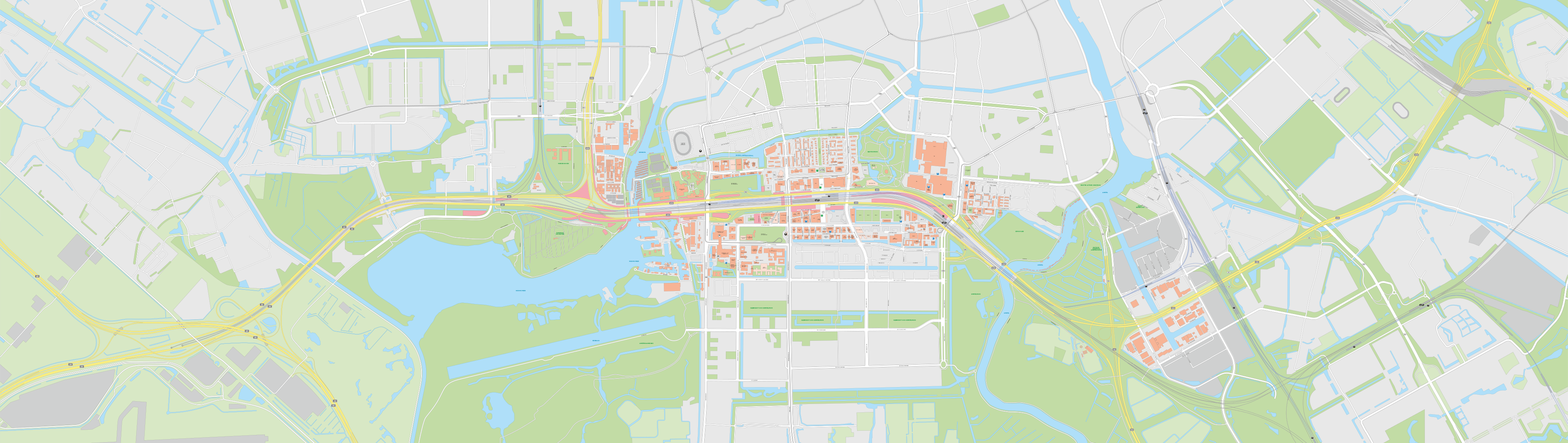
In the future, we will be fitting 55 Helmholtz resonators like this underneath the existing, most northerly Schinkelbrug bridge (bridge 2, see map). This is a very unusual move: Renders says we are the first in the Netherlands to use these sound-dampening boxes outside rather than indoors. So, why exactly are we doing it? ‘The widening of the A10 Zuid also involves increasing the number of bridges across the Schinkel. That means more traffic and therefore increased noise’, says Renders. ‘On the north side of the Schinkelbrug, we’re building a bridge for new lanes on the A10 Zuid. There are houseboats here that are located close to the existing bridge. They will be even closer to the new bridge. But it’s not permitted for residents to be exposed to more noise nuisance than in the current situation.’
Tetris wall of Helmholtz resonators
In order to reduce noise to a minimum, we have investigated what measures we can take at the Schinkelbrug. One of these is to fit Helmholtz resonators. ‘It works like this: whenever traffic drives across the bridge, this causes vibrations. These vibrations send out sound waves to the bottom and sides of the bridge. We intend to capture them there.’ This is why the resonators will be fitted to the walls of the supports underneath the bridge. ‘There’ll be two walls full of boxes of different sizes. We’re not placing them at random, but applying a specific pattern. A bit like a Tetris wall. Together with TNO, we’ve tested around six different configurations to achieve the optimum noise reduction.’
Low-frequency noise
Helmholtz resonators do not absorb all types of noise. They are specifically designed to reduce low-frequency noise, between 20 and 125 Hz. People often describe this type of noise as a strong, low hum, similar to the engine of a truck or air-conditioning. Renders: ‘For higher-frequency noise reduction, one measure we’ll be taking is to place absorbent cladding underneath the bridge: you’ll then have a sandwich of viscoelastic material – similar to memory foam – covered with a steel plate. The vibration from the deck of the bridge will end up between the deck and the steel plate and then be absorbed into that elastic material.’
Hermann von Helmholtz
Although the principle of the Helmholtz resonator is almost two centuries old – physicist Hermann von Helmholtz invented it in 1850 – TriAX has created its own unique design for the boxes under the bridge. ‘It was TNO who originally came up with the idea of using Helmholtz resonators underneath the bridge. Since this had never been done before, there followed a long phase of product development,’ recalls Renders. ‘That involved all kinds of research: what kind of materials should we use? How could we ensure that the box is as sustainable as possible? We built several prototypes that were tested by TNO. In the end, we opted for a wooden box.’
Bridge 2 to cause the most noise
Although the design may be ready, it will take some time before the Helmholtz resonators are fitted underneath the Schinkelbrug. Production will start in 2026, but they will not be fitted until after the new bridge on the north side has been completed in 2028. New bridge 1 will not actually have any Helmholtz resonators fitted at all. ‘We did investigate the possibility, but the effect of the resonators was too small. But we will be cladding much of the underside of the new bridge with noise-absorbing material. Our tests also revealed that the existing bridge 2 – where the resonators will be fitted – produces by far the most noise.’
Widening of A10 Zuid and Schinkelbrug
We are widening the A10 Zuid between the De Nieuwe Meer junction and the Amstel junction. The Schinkelbrug bridge is part of the reconstruction of the De Nieuwe Meer junction. It currently consists of five movable bridges: two for the motorway, two for the railway and one for the metro. The most southerly and oldest bridge is being demolished and replaced by two new bridges. For traffic heading to Amsterdam, we are also building two extra bridges: one on the north side and one on the south side of the existing Schinkelbrug. There will be a cycle path on the new southern bridge across the Schinkel.
Share article:
Give your opinion
Get in touch with us