
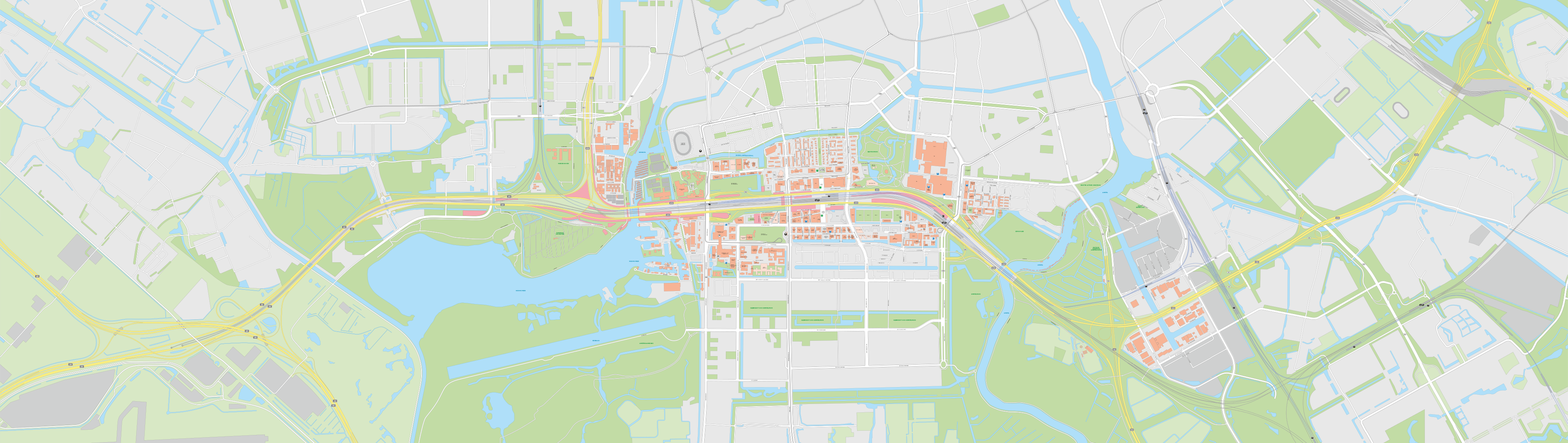
The reconstruction of the De Nieuwe Meer junction will have an impact on the living environment of people, plants and animals. The TriAX Construction Consortium (Besix, Dura Vermeer, Heijmans) is looking for and investing in opportunities for ensuring that the living environment stays as healthy and sustainable as possible during the work. This will be achieved by smart construction logistics and the reuse of materials. There will also be a focus on nature, with the addition of nature-friendly waterside areas and nesting boxes for songbirds. We have also identified other opportunities.
Opportunities
During the reconstruction of the De Nieuwe Meer junction, a continual focus on a healthy living environment will be a key priority. The ‘Nature ladder’ (see map, in Dutch) helps us to check whether we are giving the environment the attention it needs – we are currently on the third step. A key part of this is the opportunities scan: identifying opportunities for putting our ambition for a healthy and sustainable living environment into practice. This has led us to take a number of nature-inclusive and climate-adaptive measures, that aim to promote biodiversity and contribute to the best possible living environment for plants and animals. At the same time, we intend to reduce the ecological footprint: the aim is to reduce our CO2 emissions by 35% by 2030 compared to the baseline measurement taken at the start of our work in 2022.
Nature
For birds, bats and insects, we are creating habitats, including nesting boxes and insect hotels. We are installing a special wall in which sand martins and kingfishers can nest and house martins and swifts will be able to nest underneath the Schinkelbrug bridge. We are also building what are known as ecopassages intended to ensure that animals can also get past the junction. And nature-friendly waterside areas where fish and birds can thrive. We are also thinking about the trees: we are replanting as many as possible and using some of the wood for bird boxes, seating and guide rails for the ecopassages. When adding new plants, we are opting for native plant varieties and taking measures to control exotic plants – this will not only protect what we are building, but also contribute to biodiversity. Green areas can spring up in some unexpected places: Zuidasdok has been experimenting for some time with so-called Bioblocks as a green solution for the retaining walls that we will build next to the A10 Zuid. The green walls will also include habitats for bats, nesting sites for songbirds and cracks and corners suitable for insects.

Opportunities for nature around the De Nieuwe Meer junction (TriAX) (Click for enlarged view)
Smart construction logistics
As far as possible, we are sourcing the materials locally. This ensures efficient logistics with less fuel and therefore fewer emissions. We are also setting up a ‘transport hub’: a central place on one of our work sites where all the incoming materials are collected before being transported to their final destination elsewhere on the site – something that will also prevent unnecessary transport.
Reuse
We are deliberately focusing on the reuse of materials. This ranges from recycling concrete aggregate to the reuse of sheet piling and steel that has been used before. Right next to the Schinkelbrug, we are also building a viaduct that can be moved at a later stage – this requires fewer materials and less energy than a viaduct that needs to be built, demolished and then built again. We are also separating waste, for example when removing asphalt. This is being done layer by layer, enabling high-quality asphalt to be effectively separated from asphalt of lower quality. We will then be able to reuse the higher quality asphalt.
Share article:
Give your opinion
Get in touch with us