
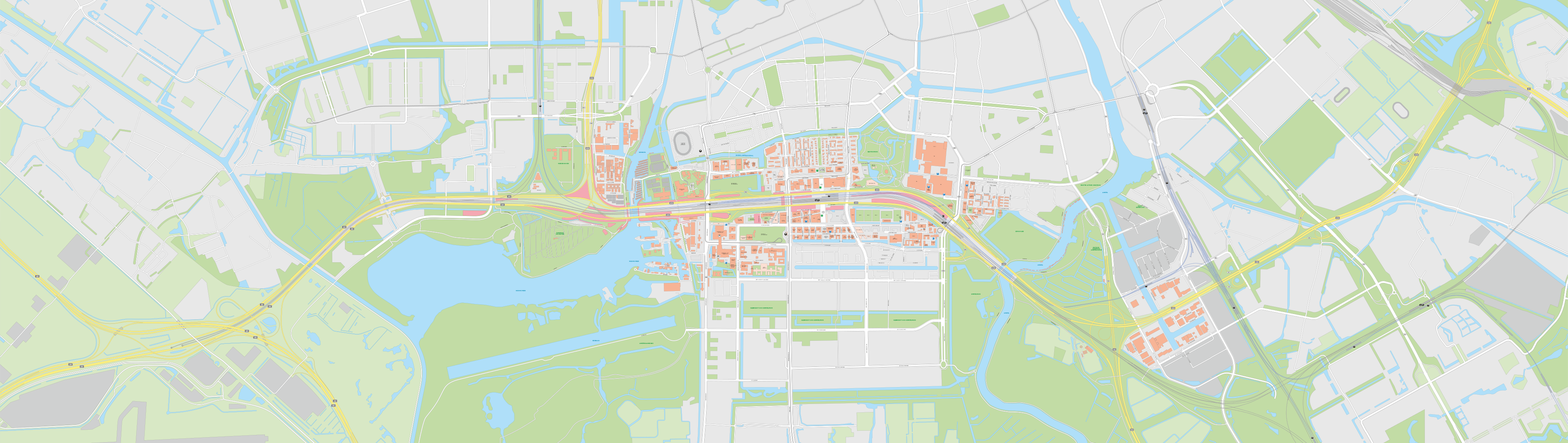
In order to widen the A10 Zuid, we need to create space in various places. One of these is the A10 Zuid embankment next to Joy Jaagpad tennis park, just to the west of the river Schinkel. Since there is so little space here, instead of building the two additional lanes intended for local traffic next to the embankment, they will be just where the embankment is now. We therefore need to dig up the embankment. We will then continue the widening of the road by building on a so-called piled embankment, basically a large number of foundation piles, on which the road will rest.
Safety
Planning engineer Jim Kerssens from the TriAX construction consortium (Besix, Dura Vermeer and Heijmans) explains how we approach the work. ‘Normally, you’d install sheet piling in order to be able to dig out a lot of soil. When you insert sheet piles into the ground, this creates an earth-retaining structure, stabilising the soil behind it’, explains Kerssens. ‘That’s not possible in this case, because we’d have to close the A10 Zuid for safety reasons too many times. This is why we’re opting to use a process known as ‘soil nailing’. This is an earth-retention technique where you actually reinforce the soil itself by means of anchors and poured concrete.’
Where are we applying this soil-nailing technique?
Starting in mid-June 2024, we will dig up the A10 Zuid embankment to the west of the river Schinkel and to the south of the Joy Jaagpad tennis park. The work will start with a test, and we will not begin the actual soil nailing (reinforcement) until September 2024. Later this year, we will be doing the same thing in other places, including next to Tripolis-Park and on the south side of the A10 Zuid, next to the Infinity building. In each of these places, we will also build a platform out of sand from which we will be able to drill the anchors (nails) into the embankment.
Drilling in nails
Put briefly, the soil nailing is done by digging up consecutive layers in strips lengthways from top to bottom. To enable the digging, we will start by drilling in anchors, referred to as nails. Hence the term soil nailing. As soon as the excess soil has been removed, the layer of earth behind it is reinforced. Kerssens: ‘We install a layer of reinforcement against this, which is also held in place by the same nails. We then pour the concrete. As soon as it hardens, an earth-retaining structure is created. You can then continue on the section underneath, and so on, until you reach the bottom.’
Sand platform
The soil will be dug up in sections of 1.5 m, ensuring that the ground behind it remains sufficiently stable. There is then a further challenge: putting the nails in. A large drilling rig is required for this and this needs to be on a platform, to enable it to start at the top. ‘The most practical way of doing this is to build a platform out of sand’, says Kerssens. ‘As you can imagine, this will require an awful lot of sand: as much as several thousand cubic metres. Ultimately, that sand will also need to be removed again in stages. Starting from 17 June, around 50 trucks will arrive and depart each day, via specially set-up construction routes: via the S107, Anthony Fokkerweg, Vliegtuigstraat and Jaagpad.
De Nieuwe Meer junction
The structural renewal of the A10 Zuid is part of Zuidasdok and begins with the large-scale reconstruction of the De Nieuwe Meer junction. We are building a new flyover and bridges across the Schinkel and widening the A10 Zuid from four to six lanes in each direction. Local traffic and through-traffic will be separated from each other. We are creating the space needed to improve traffic flow on the A10 Zuid and make it safer. To enable this to happen, major changes are required on the De Nieuwe Meer junction and later also on the Amstel junction.
Share article:
Give your opinion
Get in touch with us