
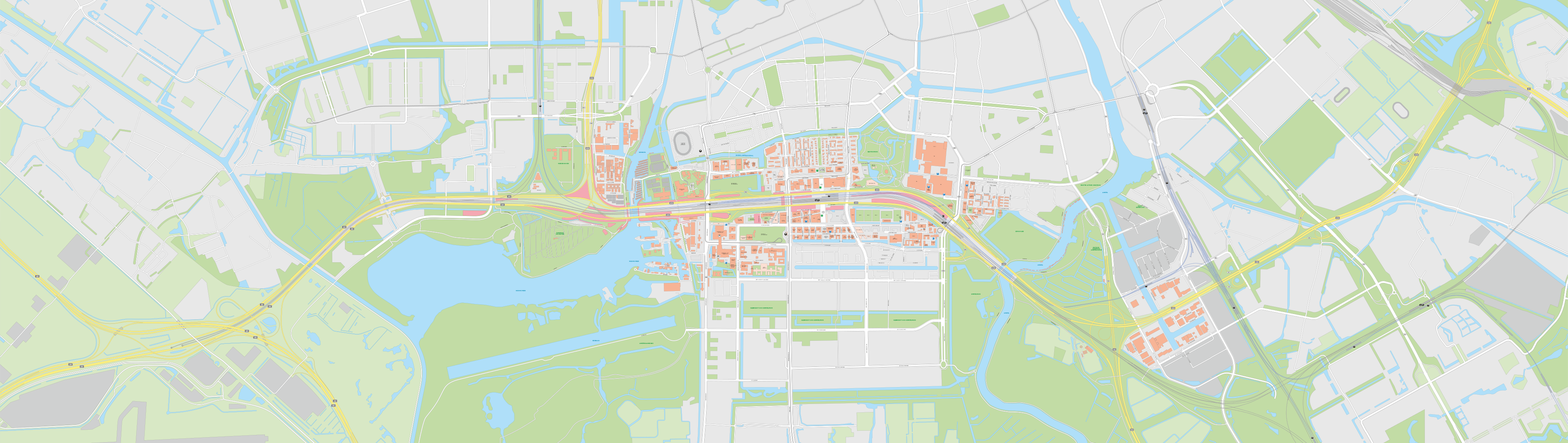
In the side streets off Gustav Mahlerplein and Zuidplein, we will be placing posts in six locations, to which sensors will be attached. On Parnassusweg too, we are placing sensors on the north and south sides, near the steps to the train platforms. These sensors will record – anonymously – the number of passing cyclists and pedestrians at a particular time, as well as their direction of travel. The sensors will not record any images; they will only register data. This data will give us a picture of how busy the various streets around Amsterdam Zuid station are and where bottlenecks are likely to occur. We need to know this information because we will be carrying out extensive construction work around the station in the next few years, especially the tunnel for the A10 Zuid. While the work is underway, we obviously would like to keep the area as functional and as safe as possible.
Red Light District and Johan Cruijff ArenA
‘The streets around the station are currently a blind spot when it comes to the flow of pedestrians’, explains Jeroen Stegeman of Zuidasdok. ‘ProRail has sensors at the entrances to Amsterdam Zuid station, and at the steps leading up to the train platforms. So we know how many people are walking into and out of the station, but not how they spread out. In addition, there are many people in the area who do not use the station, but who may only be walking to their offices, for example.’ This is not the first time we are using sensors to measure how busy public spaces are in Amsterdam. They have been successfully deployed in the Red Light District, on Kalverstraat, Vondelpark, and the area around the Johan Cruijff ArenA.
The sensors form part of the measuring and monitoring system for pedestrians and cyclists in Amsterdam’s public spaces (Langzaam Verkeer Monitoringssysteem Amsterdam, LVMA - ‘slow traffic monitoring system’). This map shows where in the city the sensors are located.
Baseline measurement
The sensors will be collecting data for two weeks, after which they will be removed in the week commencing 7 October 2024. The decision to carry out measurements at the end of September and the beginning of October was a deliberate one, as this is the busiest time of year when it comes to passenger numbers. Moreover, spreading out the measurements over the course of two weeks will give a clear picture of the fluctuations that can occur over a slightly longer period of time. Stegeman: ‘The data we will gather will enable us to set a reliable baseline measurement of the extent of the flows and numbers of passers-by in the current situation.’
Future renovation of Minervapassage
It is not only for the construction of the tunnel, but also the large-scale renovation of Amsterdam Zuid station that the measurements are important. As soon as the additional passenger tunnel (Brittenpassage) opens, in 2027 at the latest, we will be closing the current passenger tunnel (Minervapassage) for at least three years, for extensive renovation work. Stegeman: ‘After closing the current tunnel, we will again be carrying out measurements to see whether the altered flow of passengers will be in line with expectations.’ And by establishing a baseline measurement, he says, you will always have data to draw on.
Study of pedestrian flows in Minervapassage
From Monday 30 September to Wednesday 2 October 2024, we will also be carrying out a study of pedestrian flows in the existing passenger tunnel at Amsterdam Zuid station. We will be closing one of the two southern access tunnels to see whether passengers are still able to reach the station comfortably and without too much delay, even with a 50% reduction in access from the south. The reason we are doing so is to establish now what would happen if we were to partly close the tunnel for a longer period of time, starting in mid-2025. We have already done this previously, in April 2024. We are repeating the experiment now because the month of September is among the busiest of the year, with the start of the academic year and the end of the summer holidays. We need to be certain that closing one of the tunnels will not cause problems.
Share article:
Give your opinion
Get in touch with us