
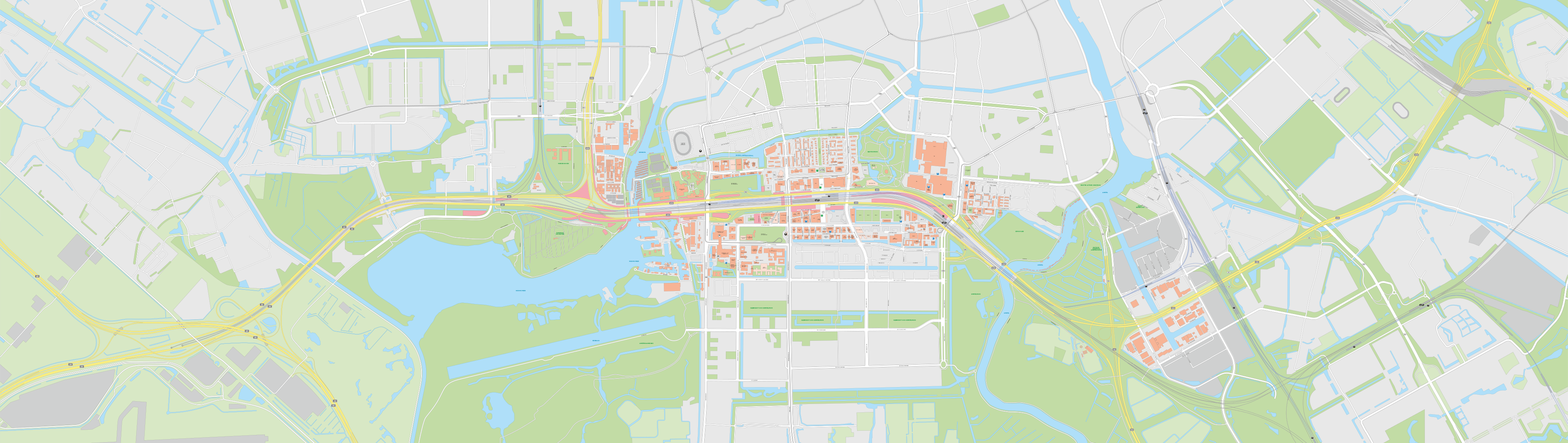
The construction of the future A10 Zuid tunnel will not start until 2027, but the preparatory work is already well underway. Before we can actually start the construction work, we first need to create space for the building site. This will be located between the dyke on which the railway and metro tracks and the A10 run on the one side, and the surrounding buildings on the other. The area will also have to remain accessible for pedestrians wishing to go to the station or to the nearby buildings. None of this would be possible in the present situation, especially on the northern carriageway (the inner ring road). That is why the first part of the construction of the tunnel is the relocation of a one-kilometre stretch of the A10 Zuid. We will be moving the motorway about five metres towards the metro and railway tracks, thereby creating more space for the construction work.
Important milestone
‘The relocation of the motorway is an important milestone in the process of building the tunnel’, says Jaap van der Kamp of VolkerWessels. As the design manager, he is closely involved with the preparatory work for the relocation. ‘Many parts of the construction pit in which we will be building the tunnel are just a few metres away from the walls of existing buildings, such as the WTC Amsterdam and the Court of Amsterdam. Once the construction pit is ready, then one of the biggest challenges we face in building the tunnel will be behind us.’ The lack of space is less of an issue for the outer part of the ring road (the A10 Zuid in the direction of Hengelo/Utrecht), as these buildings are a bit further away. But here too, we will be moving some parts of the motorway. In the area near the station, this has already been done because of the modernisation of Amsterdam Zuid station.
Atypical motorway
The relocation of the A10 Zuid is no simple operation, Van der Kamp immediately adds. ‘The A10 is not your typical motorway. Usually, the two carriageways are fairly close together, with a more or less ‘empty’ central reservation. In the case of the A10 Zuid, there is a zone of some 100 metres between the northern and southern carriageways, on which the train and metro tracks run. Moving the motorway therefore means coming up against the metro rails and all the underground infrastructure that goes with it.’
More than adding asphalt
Moreover, adds his colleague Rubert Boer of Zuidasdok, ‘there is more to moving the A10 Zuid than just digging a hole and topping it off with a layer of asphalt.’ Boer is the design manager and, like Van der Kamp, is part of the building team preparing for the construction of the tunnel, which also includes people from Zuidasdok and VolkerWessels. ‘As well as the limited space, we also have to deal with existing structures. These include the former Atrium car park under the A10, the viaducts over Parnassusweg and Beethovenstraat, and the two passenger tunnels at Amsterdam Zuid station (the current Minervapassage and the new Brittenpassage, Ed.).’
Alterations to viaducts
Boer mentions the challenges that will be faced in relation to the existing viaducts. ‘If we start moving the A10 Zuid, we will also have to make alterations to these structures. We will have to move two decks of the viaducts on which the A10 runs. This involves concrete sheets of around 60 by 22 metres, so it will be no easy task. At the same time, the substructure will also have to be altered. So there is much to do, while at the same time you cannot keep closing off Parnassusweg and Beethovenstraat – two of Amsterdam’s most important traffic arteries. And certainly not simultaneously. We are trying to do as much of the preparatory work as possible by closing the roads only partly, but achieving that with the minimum level of disruption is a real test.’
Long-term closure of A10 Zuid
To move the motorway, we will have to close the inner carriageway of the A10 Zuid (in the direction of Schiphol/Rotterdam) for several weeks – this is scheduled to take place in 2027. Boer: ‘Among other things, we will then move the decks of the viaducts to their new location.’ Van der Kamp adds: ‘During the closure, we will be doing everything that simply cannot be done while the A10 Zuid is open to traffic. The rebuilding of what is effectively a new section of motorway with new traffic systems, such as the gantries on which the blue traffic signs are attached, really does take a long time.’ The outer carriageway of the A10 Zuid (in the direction of Almere/Hengelo/Utrecht) only needs to be moved to where the two ends of the tunnel will be. On the western side, it concerns the section between Amstelveenseweg and Parnassusweg, while on the eastern side, it is the part between Beethovenstraat and Europaboulevard that will be affected. Because this work is more limited in nature, it will be carried out during the less drastic of the motorway closures.
Widening the A10 Zuid and tunnel
The tunnel will form part of the widened A10 Zuid. Two extra lanes for local (Amsterdam) traffic are to be added in both directions between the De Nieuwe Meer and Amstel junctions. The creation of the tunnel will free up around 100,000 square metres of space above ground. This will allow the expansion of Amsterdam Zuid station into a public transport hub for the metro, trains, trams, and buses. It will also make possible the addition of a third platform, with two extra tracks for international trains. The construction of the tunnel is due to start in 2027. The southern tunnel will be ready in 2034, and the northern tunnel in 2035.
This is the third article in a series about the design of the A10 Zuid tunnel and about the techniques and the challenges that it entails. Article 1 was about the preparations behind the scenes and Article 2 about the lack of space for building the tunnel.
Share article:
Give your opinion
Get in touch with us