
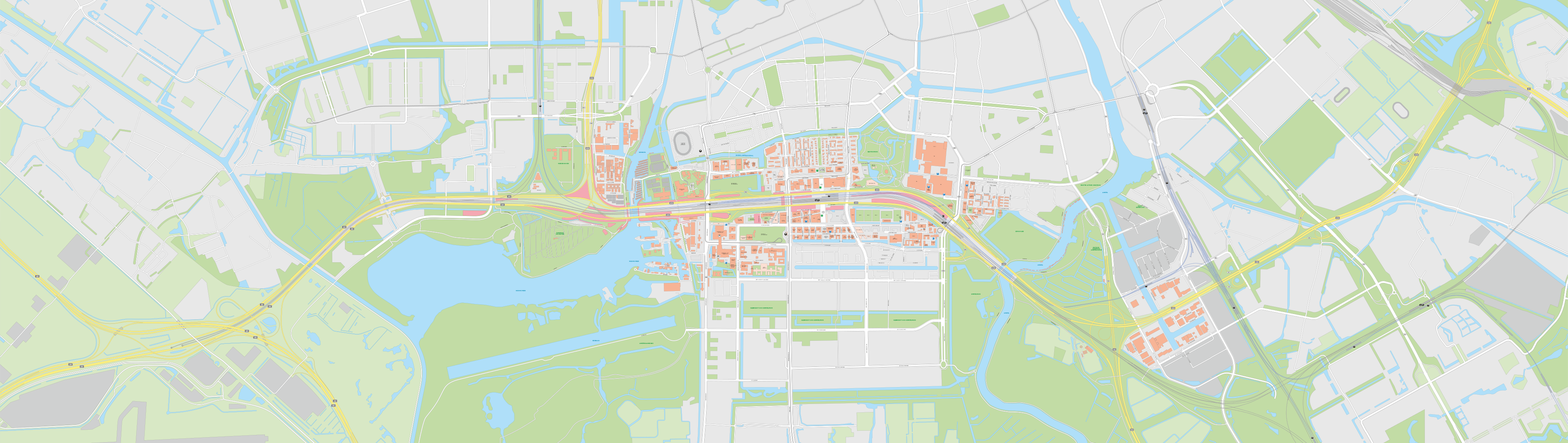
The A10 Zuid is having a parallel carriageway added to it in both directions, with extra lanes for local traffic. For this purpose, we are building an extra bridge on both the north side and the south side of the existing Schinkelbrug. Both of these are still under construction, but building the bridge on the north side (next to the houseboats in the Schinkel) is rather more complex. ‘Everywhere at the De Nieuwe Meer junction, the issue of space is a tricky one, but this applies particularly to this bridge’, explains planning engineer Darren Helle from the TriAX construction consortium (Besix, Dura Vermeer and Heijmans).
Support structure across lock
Much of the issue is due to the existing lock. This is located just where the new bridge needs a support. ‘There’s also a small building with listed-monument status that we’re not allowed to demolish and the cycle path runs straight past it. That means we’re building a support structure across the lock and the cycle path,’ explains Helle. ‘We’ve already built a large steel structure over the building. But we’ll be working well into the New Year on the whole support structure: we still have around 2.5 m of concrete to pour on top of it.’
20 cm from the existing bridge
Then there is the lack of space. ‘As soon as we start to work upwards, we get ever closer to the sides of the existing, most northerly Schinkelbrug bridge. That means that we have to pour concrete just 20 to 30 cm from the bridge in some places.’ This is especially difficult, as Helle explains, because you need to build formwork in order to pour concrete. And it needs to be possible to remove that formwork again at the end. ‘We are currently in the process of working out and calculating how we can achieve that. One of the options is to make formwork out of soluble cardboard. When the concrete hardens, there’s no need to remove the formwork, you can just let it dissolve in the water.
Gearbox
In the meantime, the other works are continuing on the bridge. For example, the ‘normal’ supports are already in scaffolding and TriAX is hard at work building the bascule cellar. In this cellar, there will be hinges that will allow the bridge to open and close. This is very intricate work: the operating mechanism is made up of huge numbers of components that link together with millimetre precision. It is like one big gearbox under the influence of some very strong forces.
Technical nerve centre
Underneath the existing Schinkelbrug, something important is also happening: we are building two service buildings there. Although they may sound dull, these buildings form the technical nerve centre of the bridge. One of the buildings will house the energy supply for all of the Schinkelbrug systems. These include the barriers, signage and the cameras for the bridge operators. The other building will accommodate the operating systems for all of these components. The aim is to connect the service buildings to the power supply by Christmas. We will begin careful testing of the initial systems in early 2026.
New Schinkelbrug for local traffic
The new northern Schinkelbrug is part of the regeneration of the A10 Zuid. From 2028, traffic coming from Amsterdam Zuid (via the S108 and S109 access roads) will use this bridge to reach the A10 West or the A4 in the direction of Schiphol/Rotterdam. As a result, local traffic on the A10 Zuid will be separated from through-traffic coming from the Amstel junction – this will improve safety and traffic flow.
Share article:
Give your opinion
Get in touch with us