
Over the coming years, as Zuidasdok is delivered step by step, we will increasingly plant trees and other greenery. This requires a long-term plan that calls for action today. At nursery Noordplant in Groningen, for example, more than 400 wild apple trees are currently being cultivated.
Starting in good time
The apple trees will not be planted at the De Nieuwe Meer junction until autumn 2027, but they need to be procured well in advance. Contract manager Paul de Bruijne explains: ‘In projects like this, procurement is usually handled by the contractor. However, because we are dealing with large quantities that are not always available at the right time and in the required quality, we have chosen to purchase the trees ourselves.’
Generous growth
Landscape designer Leonoor van der Linden saw for herself last September that the quality and dimensions met expectations. In consultation with the grower, a minor adjustment proved necessary: ‘The trees were tightly tied to their stakes. That encourages them to grow straight upwards, which allows the nursery to use its space efficiently. But we are looking for apple trees with a more generous growth habit, spreading naturally outwards.’
At a safe distance
In addition to the wild apple trees, nearly 500 black locust trees are being grown further away in the Flevopolder. Both species will eventually be planted together at the De Nieuwe Meer junction. The trees will be positioned at a safe distance from the road to ensure that branches or fruit cannot fall onto the carriageway. The new planting will be smaller in scale than the number of trees previously present, as space is required for the four additional lanes that will widen the A10 Zuid.
The wild apple tree (Malus sylvestris) is a native species that attracts bees and butterflies. Its fruit provides food for birds and small mammals. The black locust (Robinia pseudoacacia) is not native, but it performs well in the dry soil conditions along the A10 Zuid and, thanks to its extensive root system, contributes to ground stability. However, the roots must not overtake other planting. For that reason, the trees will be planted in clusters and in nutrient-poor soil to prevent excessive growth.
Green from Amstel to De Nieuwe Meer
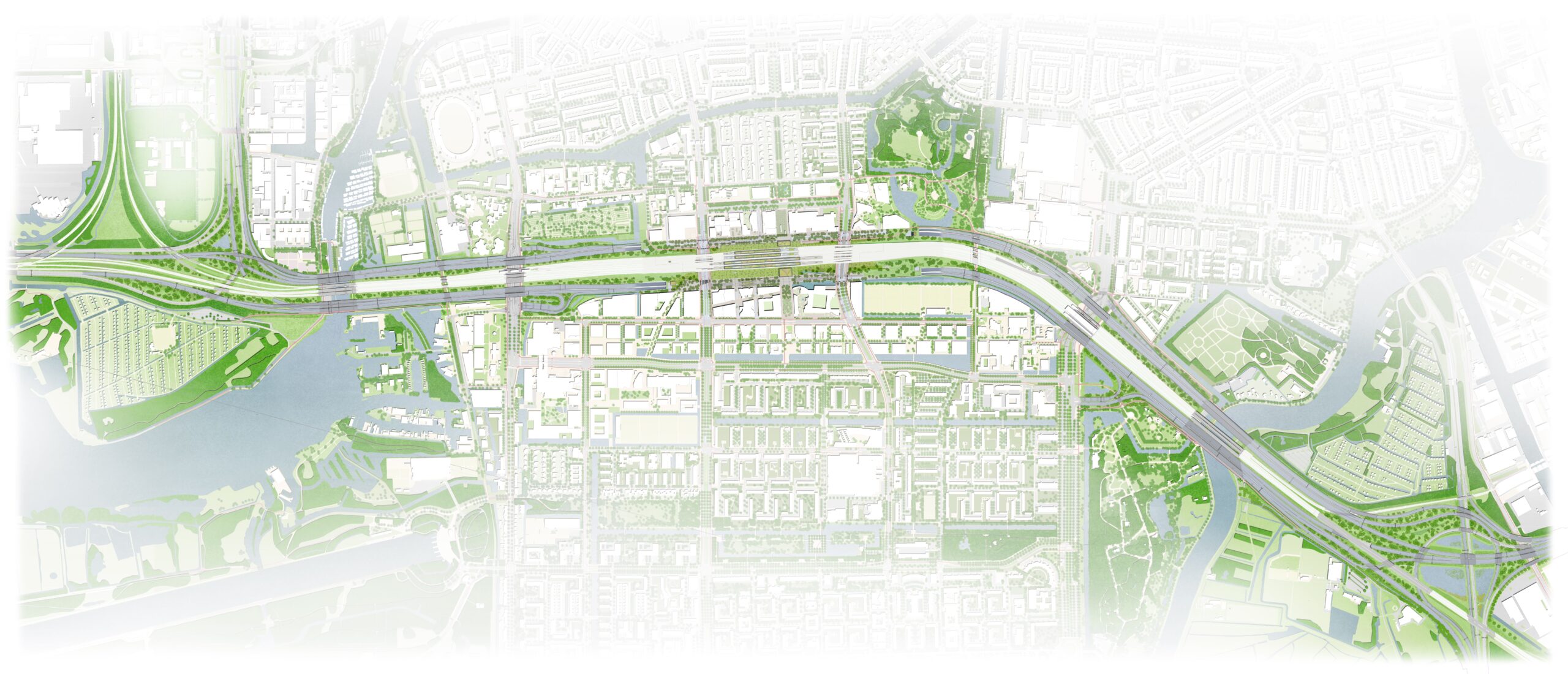
The trees contribute to what we aim to achieve with Zuidasdok: a coherent green environment alongside the widened and partially tunnelled A10 Zuid, stretching from the De Nieuwe Meer junction to the Amstel junction. Large parks and water bodies lie on both sides of Zuidas. To the west are the Amsterdamse Bos and De Nieuwe Meer; to the east, Amstelpark, Beatrixpark and the River Amstel. In the end, these areas will be connected by a continuous ‘green corridor’ of new trees, shrubs, climbing plants, waterside vegetation, flowering grasses and perennials – including the more than 900 wild apple trees and black locusts at the De Nieuwe Meer junction mentioned above.
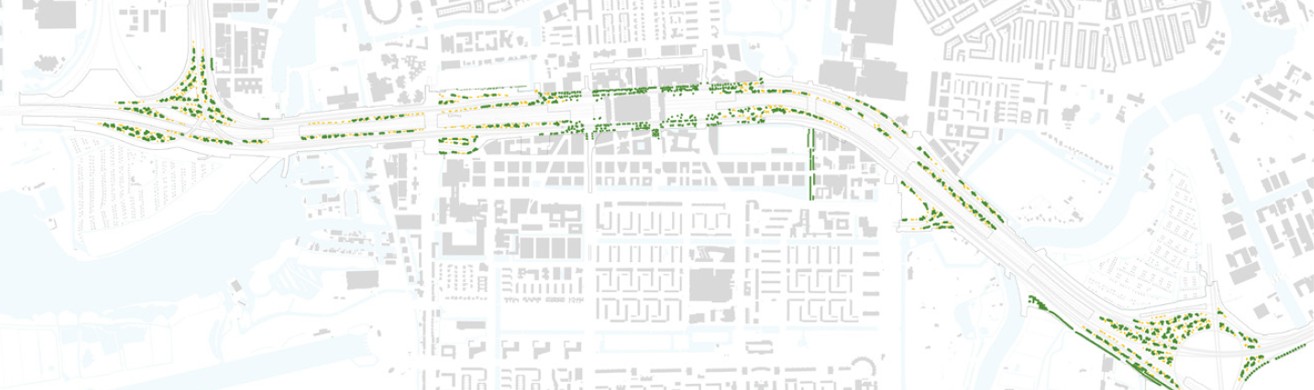
For the regeneration of the station and widening and partial tunnelling of the A10 Zuid, around 14,400 trees need to be felled. A permit was granted for this in 2017, and removal began in 2018. Not all of the trees will be replaced since there is insufficient space available. Zuidasdok will compensate for the felled trees by transplanting some of them, planting new trees and donating money to the Herplantfonds replanting fund.
Vertical greenery
We are also adding greenery wherever possible to the noise barriers that will be installed along the Ring. In some locations, this requires combining functionality and appearance in a different way, such as at the Infinity building (better known as ‘The Shoe’) along the A10. Here, there is no space for a sloping green embankment, so vertical green walls have been chosen instead.
Space for a park
Despite the expansion of the two junctions and the addition of extra lanes to the A10 Zuid, Zuidasdok also creates space. In the centre of Zuidas, the construction of the A10 tunnel will free up more than 100,000 square metres of public space above ground – roughly the equivalent of 24 football pitches. Part of this space will be used to create a new city park on top of the tunnel along the entire northern side of the station: DokDakpark. However, work on the park can only begin once the A10 tunnel has been completed, currently expected in 2035.
Share article:
Give your opinion
Get in touch with us