
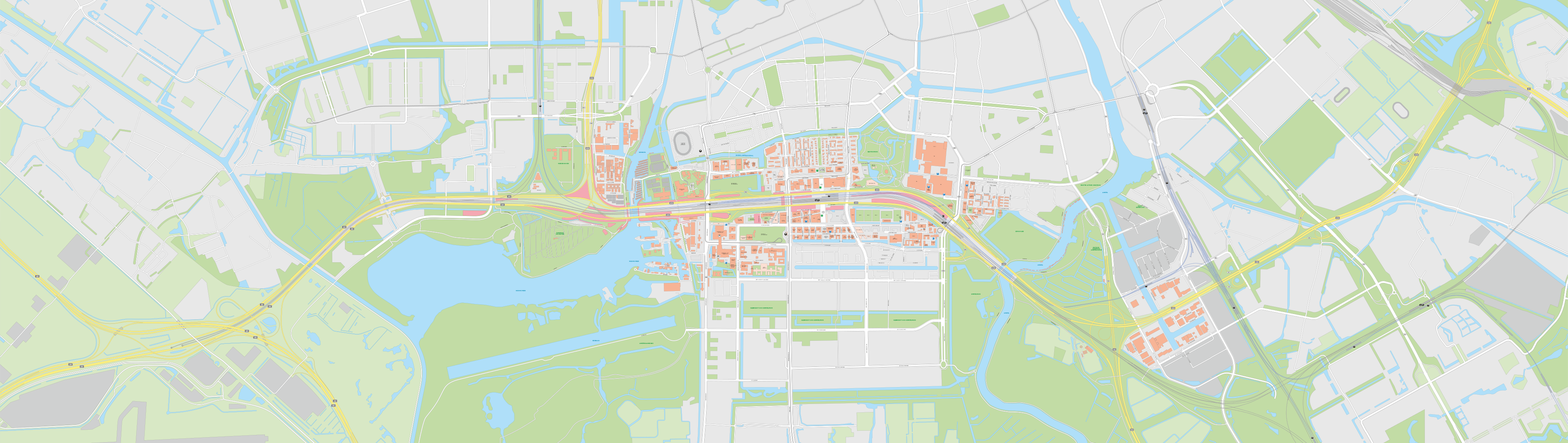
In the coming years, we will separate the A10 Zuid into a main carriageway and an additional lane for local traffic. This will improve traffic flow and safety. At the heart of Zuidas, the motorway will also be routed through the future A10 tunnel. To achieve this, the junctions at De Nieuwe Meer and Amstel will also be significantly adapted. At the Amstel junction, this includes the addition of two new bridges across the river Amstel, renovation of the existing Rozenoordbrug bridge, and the construction of ten new viaducts. Infrastructure coordinator Arno Miltenburg of construction consortium Amstel Verbindt (Boskalis, Mobilis and Van Gelder) has 40 years of experience and is currently mapping the condition and composition of the substrate and road network. ‘This way, we avoid surprises when construction starts in 2028.’
Gathering all the information
Following the awarding of the contract in 2025, we are now in the analysis phase, according to Miltenburg, during which all necessary information is collected to develop a solid design: ‘The first investigations have started and will continue until mid-April. They will help us to produce a solid provisional design this autumn and at the same time, we can keep a closer eye on cost risks; additional work due to contaminated or weakened substrate inevitably costs time and money.’
Limiting disruption
The reconstruction of the Amstel junction involves many different disciplines working together: Miltenburg’s infrastructure teams for the roads, as well as teams responsible for viaducts, bridges and traffic systems. Collecting relevant data for all these disciplines at the same time is a complex task. However, Miltenburg emphasises that it is worthwhile: ‘For road users in particular, it is better to bundle the various investigations and the associated disruption, rather than spreading them over a longer period.’
What and when?
From Monday, 16 March to Monday, 13 April 2026, we will first investigate the road surface and substrate of the main road network (A10 Zuid and A2). For four weeks, we will work only at night from Monday to Thursday, with occasional temporary closures of a lane or a slip road to or from the A10 Zuid.
This four-week period will conclude with a weekend full of major disruptions, from Friday evening 10 April to Monday morning 13 April. Due to simultaneous works at the De Nieuwe Meer junction, the A10 Zuid will be closed in both directions, the A4 in the direction of Amsterdam will be closed, and it will not be possible to travel from the A10 Noord to the A10 Oost or from the A10 Oost to the A10 Zuid. In addition, due to works at Amsterdam Zuid station, there will be no train services at Amsterdam Zuid station throughout that weekend.
From Monday, 13 April until mid-May 2026, we will investigate the road surface and substrate of the urban road network between the Europaboulevard and the Amstel; on the eastern side of the Amstel; and around the Europaboulevard. You will see us working at various locations across the project area, with local short-term closures and diversions indicated by signage.
Tar-containing asphalt
At the Amstel junction, we will modify sections of the A10 Zuid, A2 and A10 Oost. The asphalt used must not contain tar, as it includes substances that have been banned in road construction since 2001. We are therefore identifying sections of road surface that may contain tar. Miltenburg: ‘We already have a good understanding of where this occurs, based on previous core drillings to a depth of around 35 centimetres. However, there are gaps of up to half a kilometre between these earlier samples. To locate and remove tar even more precisely, we are now carrying out additional measurements using a mobile asphalt drill.’
Would you like to stay informed?
Please subscribe to our newsletter. All current and upcoming disruption can be found on our Current disruption page.
Substrate strength
At the same time, we are investigating the load-bearing capacity of the road surface through so-called structural drillings, reaching depths of around 60-70 centimetres. ‘This allows us to look beneath the 35-centimetre-thick asphalt to see what lies below’, Miltenburg explains. ‘In our case, this is usually sand.’ By means of penetration tests, we drill even deeper, up to around 40 metres below the road surface: ‘Using a special vehicle, we push a narrow steel rod with sensors into the ground. This measures resistance and soil strength. This allows us, for example, to determine the required pile lengths for the foundations of noise barriers.’
Cables, pipes, Japanese knotweed and more
The three types of investigation mentioned above are only part of the picture. We will also dig test trenches to map cables and pipelines, as well as the presence of Japanese knotweed; we will carry out deflection measurements to assess the lifespan of the asphalt; and we will even conduct investigations in the river Amstel to test water quality and identify any remaining structures. In total, this amounts to more than 20 different investigations. Miltenburg: ‘And these are only the investigations needed for the provisional design, which we aim to complete by mid-October. From the second week of September, after the summer construction break, we will continue by monitoring the condition of existing structures, such as bridges. By then, we will have all the information we need to confidently start construction in 2028.’
Reconstruction of Amstel junction
The reconstruction of the Amstel junction (construction starting in 2028, with completion expected in 2037) is the final major project of Zuidasdok and encompasses the regeneration of the A10 Zuid from the Amstel junction to the Europaboulevard. This regeneration will improve traffic flow and enhance safety by separating through traffic and local traffic, and by adding two extra lanes in both directions.
In addition to widening the A10, the project includes new connections between the A10 Oost and the A10 Zuid, replacement of the southern Rozenoordbrug bridge, construction of several new viaducts, adjustments to urban roads, and the installation of noise barriers. The works are divided into two subprojects: one for the north side and one for the south side of the junction. Funding is currently available for the south side, which will therefore be carried out first. The realisation of the north side depends on additional funding.
Share article:
Give your opinion
Get in touch with us