
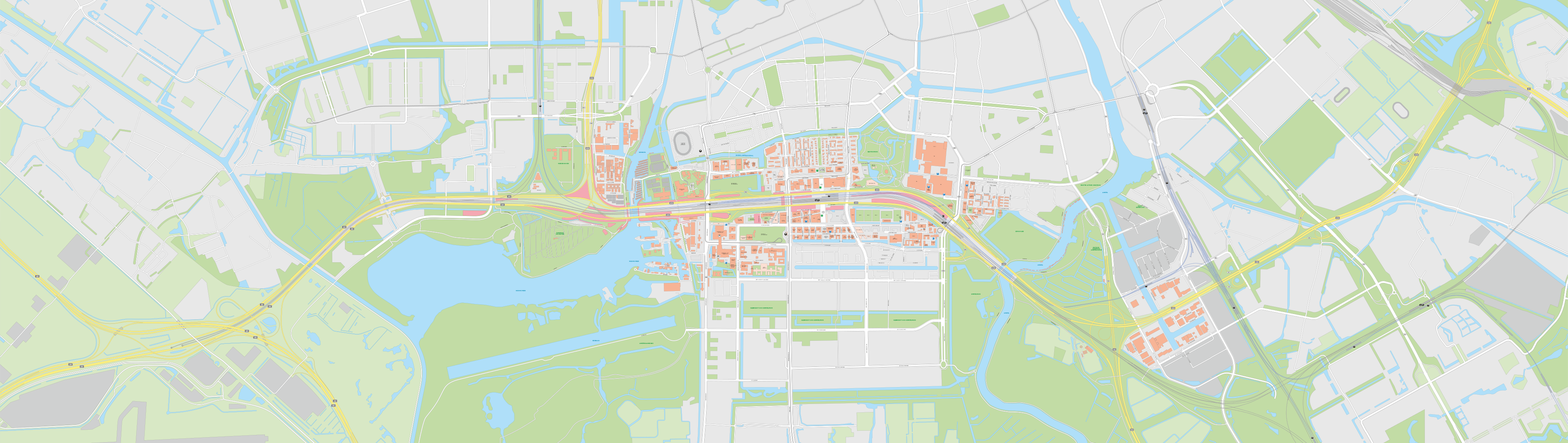
The deck of the existing southern Rozenoordbrug, which forms part of the reconstruction of the Amstel junction, needs to be replaced. Rozenoordbrug currently consists of two road bridges, each with four lanes, two railway bridges and one metro bridge. The southern bridge also has a lower-level path for cyclists and pedestrians. The deck of this southern Rozenoordbrug will eventually be demolished. But before that happens, we are investigating how this can be done as safely as possible.
Ultrasonic pulse-echo measurements
In preparation for the reconstruction of the Amstel junction, we previously carried out soil surveys beneath the A10 Zuid and in the riverbed of the Amstel. This spring, we also investigated the bridge abutments and piers. This summer, however, Amstel Verbindt construction consortium (Boskalis, Mobilis and Van Gelder), together with Nebest, also investigated the inside of the bridge. They used what are known as ultrasonic pulse-echo measurements. These use ultrasonic sound waves that cannot be heard by humans to create an image of the bridge structure from the inside. The video below shows exactly how this works.

It all comes down to how well the ducts are filled
Prestressing plays an important role in the strength of the bridge. ‘Prestressing is a system in which hollow ducts are incorporated into the structure when the bridge is built’, explains Rijnard van de Werfhorst, Works Planner at Amstel Verbindt. ‘Steel cables – the prestressing tendons – are installed in these ducts. Once the concrete in the bridge deck has hardened, the tendons are tensioned. The space around them is then filled with grout, a mixture of cement and water. This ensures that the steel prestressing tendons bond properly with the concrete structure. It also protects the tendons.’ The measurements are specifically intended to determine whether the space around the tendons has been sufficiently filled with grout. In other words, how completely the ducts have been filled.
Insufficient grouting
The measurements will now be followed by an extensive analysis, and we are currently awaiting the results. ‘If the space around a tendon has not been grouted sufficiently or at all, there is insufficient bonding’, says Van de Werfhorst. If a prestressing tendon is then cut during demolition, it loses its tension. ‘This could make the bridge structure unstable and could even cause it to fail. We want to prevent that at all costs – or at the very least be prepared for it.’
Inside the bridge through an access hatch
Road users will not have noticed anything of the investigation. Traffic continued to flow as normal while the measurements were being carried out. ‘We can take the measurements without damaging the structure’, says Martijn van Zandwijk, Project Manager for Concrete Investigations at Nebest. An access hatch allows him to enter the box-girder structure beneath the road deck, where some of the measurements are carried out. Orange chalk lines have been drawn on the walls of the box girder. ‘The lines indicate the locations of the tendons, which we identified using radar equipment.’ The echo equipment does the rest.
Build first, replace later
The southern Rozenoordbrug was strengthened in 2022 because its structural safety could no longer be sufficiently guaranteed. This measure is expected to extend the bridge’s service life by around ten years, until 2032. This enables us to replace the bridge in stages. First, a new bridge will be built on the southern side of the existing bridge. Only once this new connection is in use can the existing deck of the southern Rozenoordbrug be replaced. This approach ensures that sufficient capacity remains available for traffic throughout the works.
Reconstruction of Amstel junction
The reconstruction of the Amstel junction (with construction starting in 2028 and completion currently expected in 2037) is the final major project of Zuidasdok. It involves modifications to the A10 Zuid from the Amstel junction up to and including Europaboulevard. The reconstruction will make the A10 Zuid safer by separating through traffic from local traffic and adding two extra lanes in each direction. In addition to widening the A10, the project includes new connections between the A10 Oost and A10 Zuid, replacement of the southern Rozenoordbrug, construction of several new viaducts, modifications to local roads and the installation of noise barriers.
Share article:
Give your opinion
Get in touch with us