
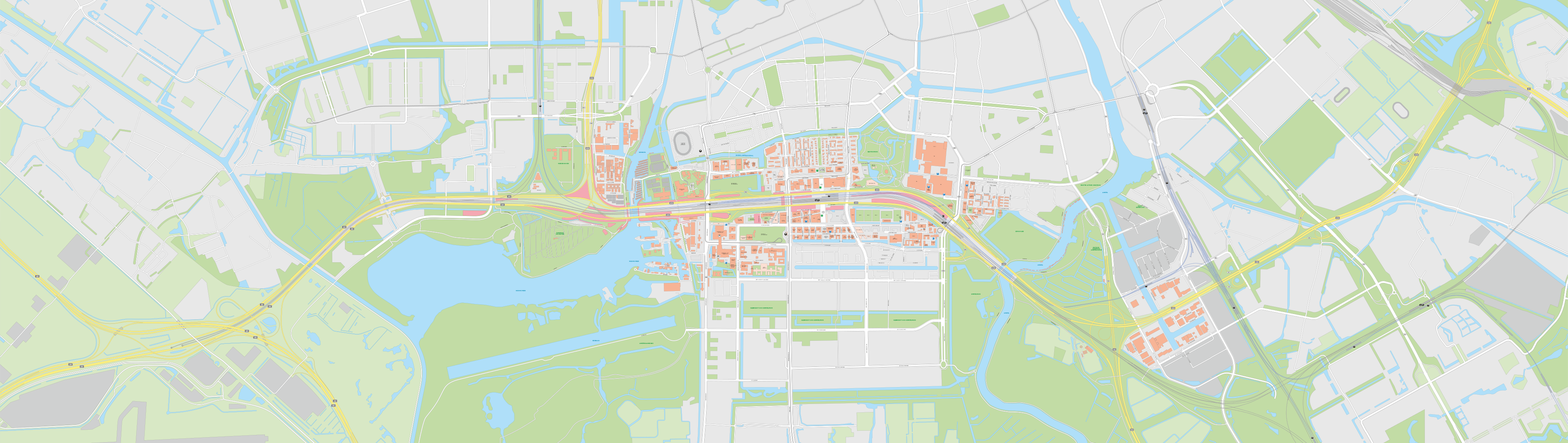
The Atrium car park, in Eduard van Beinumstraat, has been out of use for several years, but has not yet been completely removed. This is no easy task, because the A10 runs right over it. This two-storey car park also still serves as foundations. Despite this, we are demolishing the remaining structure, 140 m in length and 21 m deep, in phases. This will be the location of the entrance to the second passenger tunnel we are currently building, the Brittenpassage. At the moment, we are demolishing the floor between the two parking levels.
Roof sections
Most of the roof for this new passage has already been built in sections. Between 5 and 14 August we will be moving another two huge roof sections into position. The last (seventh) section of the Brittenpassage roof will go underneath the most northerly metro track (used by metro trains 50 and 51 in the direction of Isolatorweg). We are building this roof section between the metro tracks and, according to the current schedule, it will be moved underneath the metro track in the summer of 2024.
Installing sheet piling
Before then, lots of other things need to happen. The extremely heavy roof section will of course require very sturdy supports. In order to be able to build them, we first need to place sheet piles in the ground. At one end of the metro track concerned – the south side – we have already created the sheet pile wall. We will do the same on the north side in September 2023: between the metro track and the A10. In order to install the sheet piling in the ground, we will be placing some heavy-duty equipment on the A10. For this reason, the A10 Zuid in the direction of the A4 Schiphol/The Hague and the A10 West will be closed for two weekends in September 2023.
Demolition of car park floor
When sheet pile walls have been installed at both ends of the metro track, we will connect them both using anchor rods: horizontal iron rods that ensure that both sheet pile walls remain stable when we have dug the construction pit. Currently the old Atrium car park is preventing these horizontal anchor rods from being put in place. ‘We can’t demolish the whole car park, because otherwise the A10 would collapse’, says Stephan Keizer, head foreman for the Nieuw-Zuid construction consortium, responsible for doing the job. ‘Removing the flooring on the first floor of the car park will enable us to use our equipment to position the anchor rods.’ Preparations for this demolition work are already under way. Keizer: ‘Obviously, we can’t just use a wrecking ball to demolish those floors. Traffic drives over them, so it has to be a very careful operation. We’ve already sawn into the concrete floors. In the first week of August, we’ll drive remote-controlled carts into there. They will lift the floor beams up slightly and push them outside. They’ll then be transported to our work site in Eduard van Beinumstraat. There, they’ll be broken into pieces that can be transported.’
Completely recycled
The rubble from the Atrium car park will then be sent to the Urban Mine company in Zaanstad. This company specialises in recycling demolition rubble, using it to make new concrete. In fact: this concrete will be used later to make the roof section that will be underneath the metro track. The debris from the Atrium car park will actually be put to circular use. Urban Mine also uses low-energy methods, working with solar energy and rainwater. The concrete produced requires 80% lower CO2 emissions than conventionally-produced concrete.
How will it affect you?
We are using the quietest techniques possible. The removal of the concrete floors and processing of the rubble will be done with a concrete mesh cutter. While sawing into the floors, the contractor used fabric noise-control barriers. These works will last until the end of August, between 09.00 and 19.00 on working days.
Share article:
Give your opinion
Get in touch with us