
Anyone driving, walking or cycling past The Pulse of Amsterdam via Gustav Mahlerlaan will certainly have noticed it. The residential tower – 151 mid-market rental apartments and 49 private-sector rental homes – has become slightly exposed. The scaffolding has been removed, suddenly revealing a section of the façade. Its tiered structure, combined with the colour of the stonework, is clearly reminiscent of the Amsterdam School style of architecture. It will not be long before the residential tower can be admired in its full glory from all sides: this part of the multifunctional complex is more or less complete and the scaffolding is being gradually removed starting in July 2024. ‘We’re working our way down at a pace of around two or three floors per week’, says Martijn Stekelbos, project manager for the contractor VORM Bouw. ‘In just a few weeks’ time, the façade will be clearly visible from the A10. The scaffolding should be more or less gone by September.’
Every single millimetre matters
The office tower – which protrudes into the air like a mushroom thanks to the use of prefab façade elements – is also virtually complete. Just like in the residential tower, the contractor is also currently doing the internal finishing on this part of the building. Finishing off the stairways, laying the computer flooring, installing the ceiling fittings and so on. The building is now rapidly nearing completion, scheduled for the end of 2024. ‘Although we’re still on schedule, we really do need the time we have left. The complexity of the building is the main challenge we face’, says Stekelbos as we walk across a construction site towards the main entrance of Pulse, on the Parnassusweg side. ‘This is certainly not your conventional square building: it features different levels, numerous diverging corners, slanted façades and ceilings. One of the floors even has a zigzagging glass atrium roof: in order to ensure everything fits together perfectly, every single millimetre matters.’
Blurring zone
The northern section of the plinth (the base of the building or ground floor) will feature what is known as a ‘blurring zone’. Stekelbos: ‘The idea is for this not only to be a space for people who work or live here, but a pleasant place for people to meet and pass through.’ There will be hospitality outlets, plenty of planting and the entrance to the cinema on the first floor of the central section of The Pulse. Stekelbos points towards a wide concrete stairway structure. ‘This will be one of the staircases leading to the cinema. We plan to clad it in bamboo, creating not only a staircase, but also bench-style seating. The whole of the blurring zone boasts wonderful natural daylight thanks to the tall glass façade overlooking the A10. All of it will be given a very luxury finish: in addition to all the bamboo and plants, there’ll even be a terrazzo floor.’
Structure of cinema auditoria
On the first floor of the ten-storey central section, we take a look in what will ultimately be the cinema. It will have a total of nine auditoria, including three smaller, intimate spaces and one huge main screen. ‘Just listen for a moment’, says Stekelbos as we enter the room. Remarkably, the construction noises from elsewhere in the complex and the noise of the motorway have disappeared. ‘All of the cinema ceilings have been fitted with noise-insulating material. But that’s not all. We used a box-in-box design when building all of the auditoria. You’re actually building a room inside another room, insulating it acoustically. Achieving that is far from easy, because the floors, walls and so on have to be attached to each other with special noise-damping materials.’
Very high trees
Finally, we take a look on top of the central section, at the newly landscaped ‘urban forest’. It’s spectacular: an undulating, already green section of the city at a height of 35 m, complete with around 70 trees. ‘As you can see, the trees are already quite a size, making it already feel very lush. The trees had around 2.5 years to grow at the nursery, before we lifted them onto the roof.’ The trees survived the first summer storms intact. Stekelbos: ‘Of course, that was quite nerve-wracking, but everything is firmly in place. The trees are attached to stakes and the whole deck underneath them has been carefully strapped to the roof.’ The final touches are currently being added to the planting. A steel structure with a railing will follow later and ultimately serve as a path through the green roof park. It will then be possible to access it from the office building below and it will only remain accessible to tenants of the office section of The Pulse of Amsterdam.
Kenniskwartier
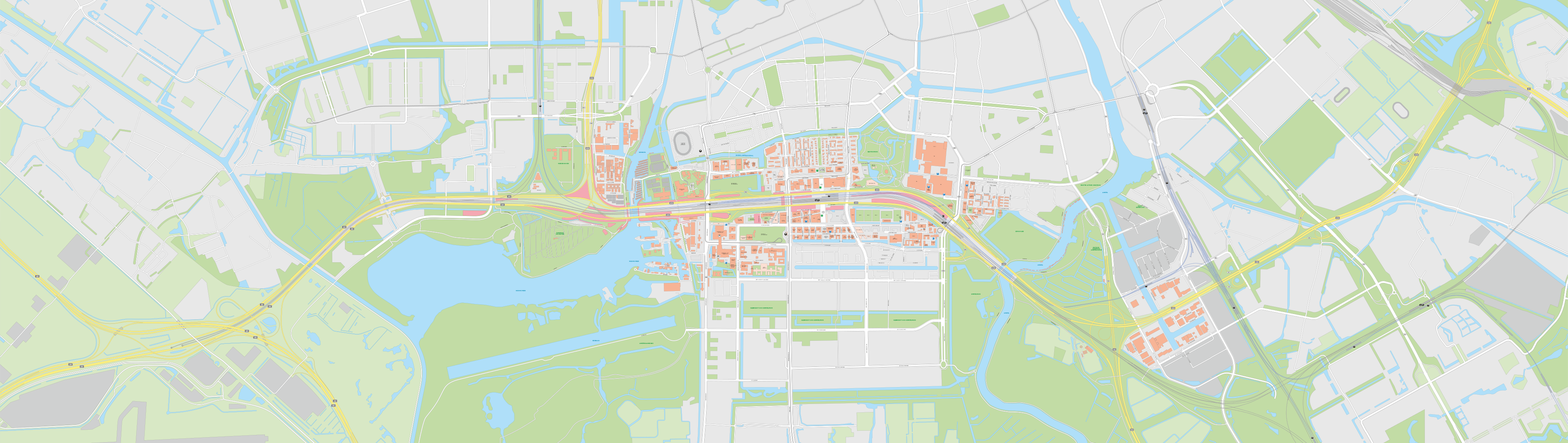
In the years ahead, we are working with VU and Amsterdam UMC to transform the Kenniskwartier in Zuidas into an exciting mixture that brings together a wide variety of different functions. In this neighbourhood (on the south side of the A10, between Parnassusweg/Buitenveldertselaan, A.J. Ernststraat and Amstelveenseweg), there will be around 2,700 homes alongside space for education and knowledge-related business, healthcare, culture, shops and hospitality. Boasting The Pulse of Amsterdam, the new ADORE Research and Diagnostic Centre, Rialto VU cinema and the social housing project Stepstone, the Kenniskwartier is set to become a place that brings together housing, interaction, inspiration and knowledge-sharing. The Pulse of Amsterdam is expected to be completed by the end of 2024 and is being developed by VORM and EDGE.
Share article:
Give your opinion
Get in touch with us