
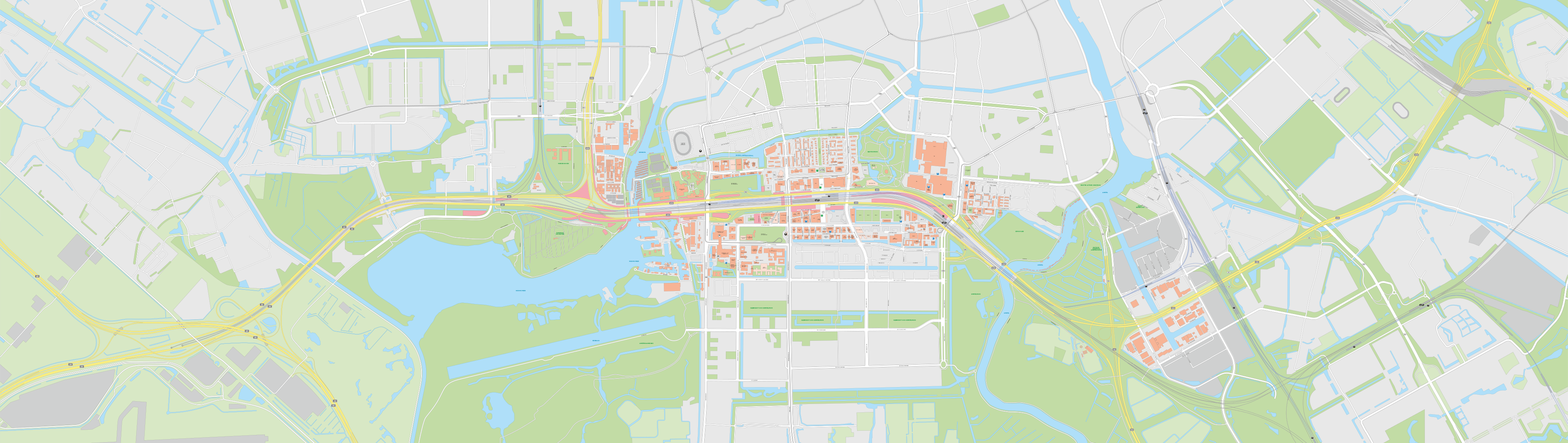
We already reported that work is well and truly underway on the foundations of the Ravelly residential tower, the first 75 (social rented) homes in the new car-free Ravel residential district. When the neighbourhood is completed in 2035, two-thirds of it will be housing. We asked project manager Thijs Koolmees what we should expect in the years ahead: ‘It’s set to be a vibrant, green residential district with lots of amenities and services, in what may be the most accessible place in the Netherlands.’
1,350 homes for every budget
In Ravel, there will be around 1,350 homes, divided up in the familiar 40-40-20 ratio: 40% social rented homes, 40% mid-market rented and owner-occupied homes and 20% free-market sector homes. ‘With a considerable number of homes for families in each sector’, adds Koolmees. A quarter of the space will also be used for offices (totalling around 60,000 sq. m. if all floors are included) and the rest for amenities and services, such as education, healthcare, retail trade and hospitality/catering.
Vibrant mix
This wide diversity of functions is expected to bring vibrancy. ‘A mixed district is pleasant for employees and residents alike’, explains Koolmees. ‘There’s life on the street at all times of day. This creates opportunities for businesses, such as a bookshop, which in turn makes the neighbourhood even more attractive for residents and employees. This is why we no longer develop any single-function neighbourhoods.’
Creating space
In order to create space for the new residential district, all of the Goed Genoeg sports park fields had to be relocated alongside the A10 Zuid to the north of the new Maurice Ravellaan. In 2022, the last field was moved, completing the regeneration of the sports park.
Park
So, how will Ravel be different from other neighbourhoods in Zuidas? ‘When drawing up plans for Ravel, we carefully examined the Gershwin neighbourhood in the centre of Zuidas’, says Koolmees. ‘We’ve learnt lessons from that, partly based on the experiences of residents. For example, Gershwin features a street layout with a lot of space for cars, delivery services and so on. The public space in Ravel will look much more like a park, with plenty of green areas and space for interaction and relaxation.’ You will be able to read much more about the design of the public space soon.
Car-free
Koolmees also tells us not to expect roads covered in asphalt in Ravel. ‘Only the emergency services, sweeper trucks and parties like the grid operator Liander will be able to access the neighbourhood by car or van. We’ve charted out a route especially for that.’ Instead of car parking spaces on the street, there will be walkways and green areas: ‘There are already two large public car parks underneath the Valley building and the Goed Genoeg sports park.’ That does not mean that there will be no parking whatsoever; future developers will be given guidelines for parking spaces designed for shared mobility and disabled drivers. Underground space has been set aside for that in two places on Maurice Ravellaan.
Clockwise construction
We will finish building the western part of the Ravel residential district first. We have already started relocating the Kindercampus Zuidas and the construction work on Ravelly. The construction of Tic Tac Toe will follow in 2025. We will then work in a clockwise direction towards The Harmony and the adjacent plots until we reach the new Maurice Ravellaan. When the western part of the residential district, complete with public space, has been completed in 2030, we will start on the eastern half. The Ravel residential district is expected to be completed by 2035.
Schedule
Work on the Ravelly residential tower (75 social rented homes, to be completed by mid-2026) is already well underway. Construction work on 148 affordable homes, office accommodation and community amenities in the multifunctional building The Harmony is expected to start in mid-2026 and be completed by 2028. The environmental permit for the 75 family homes in Tic-Tac-Toe (to be completed by 2027) has now been approved – construction work is set to start in after the summer of 2025. Work on the amenities is underway with the relocation of Kindercampus Zuidas (to be completed in the fourth quarter of 2025). The Ravel residential district is expected to be completed by 2035.
Within walking distance
Would Koolmees actually like to live there himself? He laughs: ‘The designs look very promising, with top-quality materials and excellent insulation. And all of that at the heart of a green neighbourhood, with a school and sports fields just round the corner.’ He then points outside towards Amsterdam Zuid station: ‘And the gateway to the rest of Amsterdam, and the whole of the Netherlands, is within walking distance.’
No hotels
Plans for a new neighbourhood in Zuidas date back to the start of the century in around 2003. For a long time, the focus of the development was on offices and hotels. This later shifted to housing. In any case, the hotel policy in Amsterdam was also becoming increasingly strict. By 2020, hotels had disappeared completely from the plans for the new Ravel district: housing, employment and leisure became the new watchwords.
Share article:
Give your opinion
Get in touch with us