
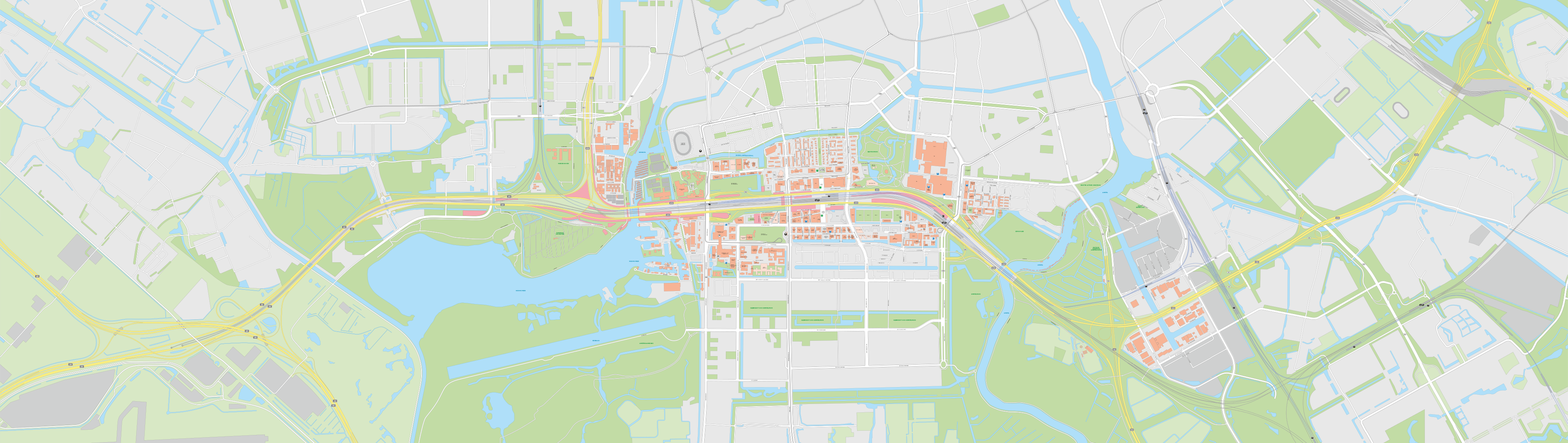
According to current estimates, approximately 150,000 transport movements will be required between 2027 and 2035 for the construction of the A10 tunnel. This includes the delivery of machinery and materials, as well as the removal of no less than 830,000 cubic metres of earth – equivalent to around 55,000 transports on its own. This will add pressure to an already busy area, while we must continue to keep Amsterdam Zuid station and the Zuidas district operational, safe and accessible throughout construction. Dédé Reichart, Coordinator of Phasing and Logistics at Zuidasdok, explains how we plan to achieve this.
Reducing pressure on the urban road network
One of the key questions was how to move construction traffic in and out of the centrally located station area. The most obvious routes would be the nearby Parnassusweg on the west side and Beethovenstraat on the east side. However, Reichart explains why this is not the preferred solution: ‘These are important north–south routes carrying large volumes of car and bus traffic, while Parnassusweg also accommodates tram services. The station area is also full of cyclists, pedestrians and public transport passengers travelling to and from Amsterdam Zuid station. We want to avoid mixing them with construction traffic wherever possible – especially for safety reasons.’

Using the tunnel itself as a logistics route
Contractor VolkerWessels therefore developed a way of reducing pressure on the urban road network. If we want to minimise the use of Parnassusweg and Beethovenstraat, we simply go underneath them. The solution is to work from the outside inwards and use the tunnel itself as the main logistics route.
Working inwards from both sides
Construction will begin at the edges of the project area: the Amstelveenseweg in the west and the Europaboulevard in the east. From there, excavation will gradually progress towards Amsterdam Zuid station from both directions. Eventually, the works will reach Parnassusweg and Beethovenstraat. At these locations, part of the roadway will be replaced with a concrete slab – the future roof of the tunnel – allowing traffic to continue using the road shortly afterwards. Beneath this roof structure, excavation can continue, creating an underground crossing for the transport of construction materials to and from the station area.
As previously reported, both the northern and southern tunnels will consist of two separate tunnel tubes: an outer tunnel tube with two lanes for local traffic, and an inner tunnel tube with four lanes for through traffic. Both will play a vital role in the logistics operation, Reichart explains: ‘In certain situations, transport vehicles will enter the tunnel via the outer tunnel tube, deliver their materials, turn around, and then return via the other tunnel tube.’
Vertical transfer points
The next challenge is moving materials from the tunnel to ground level, as sections beyond the crossings will not yet have been excavated. To overcome this height difference, special portals will be installed to lift materials and excavated soil up and down. Reichart explains: ‘This solution can only be used for materials up to 16 metres long. Longer items such as anchor piles, sheet piles and pipe piles will unfortunately still need to be transported via Parnassusweg and Beethovenstraat. We will therefore schedule those movements at night, outside busy daytime traffic periods, and under supervision.’
Two U-shaped construction routes
Using the tunnel under construction as a logistics route reduces pressure on Parnassusweg and Beethovenstraat. Wherever possible, we will also make use of the existing motorway network, the A10 Zuid. After all, tens of thousands of vehicles already use the motorway every day, meaning that around 80 additional construction transports per day will have very limited impact. To support this approach, two U-shaped construction routes will be created, one on each side of the project area. These routes will connect construction traffic directly from the A10 Zuid to the tunnel via dedicated construction entry and exit points (BIUs). After delivering materials, vehicles will return to the construction route in the direction of Parnassusweg and Beethovenstraat. There, the construction route – which is completely separated from regular traffic – curves towards another BIU on the opposite side of the A10 Zuid, allowing vehicles to return in the direction from which they came.
Image below: the A10 Zuid in both directions (main carriageway right (HRR) towards the A10 West/A4, main carriageway left (HRL) towards the A10 Oost/A2); the U-shaped construction routes (purple); the tunnel logistics route (blue); and the four transfer portals (green) located centrally at Parnassusweg (PW) and Beethovenstraat (BS).
To connect the U-shaped construction routes to the A10 Zuid, BIUs will be created at both the S108/Amstelveenseweg and the S109/Europaboulevard, in both directions of travel. Reichart: ‘The entire logistics concept is designed to avoid creating bottlenecks for ourselves. That is why three of the four connections to the A10 Zuid will function as both entry and exit points. This means construction traffic does not always have to complete the entire U-shaped route and can, where necessary, return directly to the motorway using the same connection.’
Preliminary design progressing to final design
At present, Reichart – a member of the project team representing contractor VolkerWessels and Zuidasdok – is not yet able to provide a definitive schedule. ‘We are currently developing the preliminary design into a final design. This should be completed by the end of this year and will include a comprehensive logistics plan. The finer details are still being worked out, but one thing is already certain: We will begin excavation from the outer edges of the project area.’ According to the current schedule, construction of the tunnel will start in 2027, with completion of the A10 tunnel expected in 2035.
This is the ninth article in a series about the design of the A10 Zuid tunnel and about the techniques and challenges involved. The first article was about preparations behind the scenes, the second article looked at the lack of space for construction of the tunnel, the third article was about moving the A10 Zuid, the fourth article focused on keeping Amsterdam Zuid station accessible during construction, the fifth article explored earth-retention techniques, the sixth article was about technical installations, the seventh article focused on the removal of earth produced during the construction of the tunnel and the eighth article was about the 10 hectares of public space that will be created as a result of the A10 tunnel.
Share article:
Give your opinion
Get in touch with us