
There is a smell of coffee and shower gel in the air as Jeroen Monnik, construction manager of the Public Transit Termina (OVT) arrives at the first meeting of the day at 07.30. The group quickly discuss the preparation plans for the works for which the A10 Zuid will close for an eight-day period in August. At around lunchtime (and three meetings later), we have a better idea of Monnik’s overall role. ‘Without my own OVT team, my colleagues from the Nieuw-Zuid construction consortium and all the workers outside, of course I’d get no work done’, he says. ‘But when it comes to ensuring this job is completed, I’m more or less responsible for everything on behalf of our clients.’
Pushing the Brittenpassage roof into position
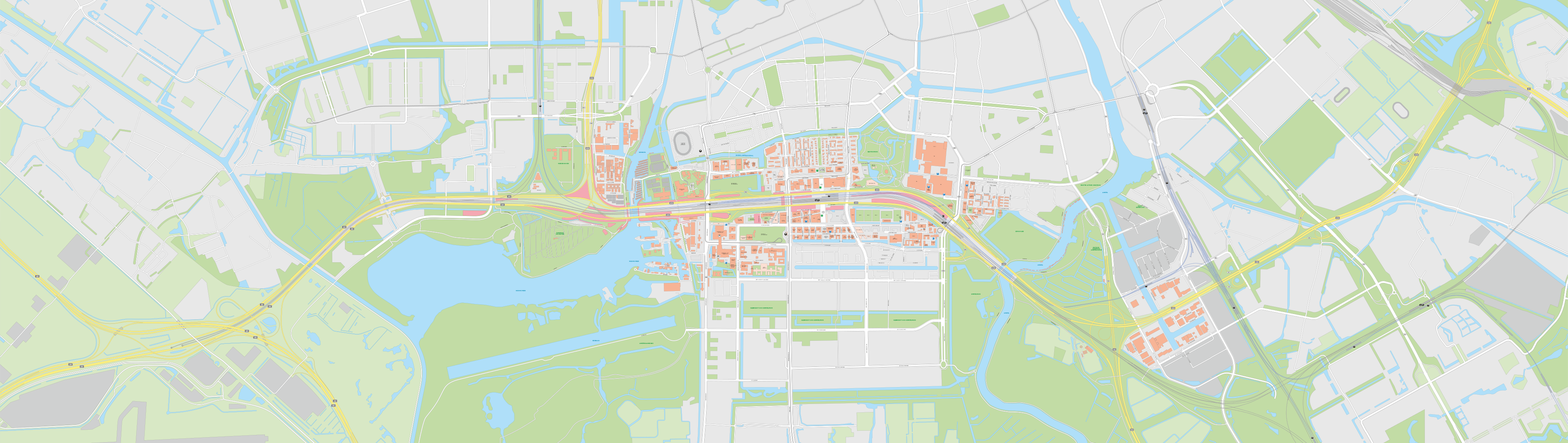
Monnik is currently working on behalf of ProRail for Zuidasdok, the massive infrastructure project involving the regeneration of Amsterdam Zuid station and the widening and partial undertunnelling of the A10 Zuid. In August, we moved two gigantic concrete sheets from our work site on the south of the ring road to their ultimate position: under railway track 1 and future railway tracks 5 and 6, and underneath the A10. They make up the roof of the additional station passageway at Amsterdam Zuid station: the Brittenpassage. When these two roof sections are in position, we will be able to dig out the Brittenpassage underneath them. Monnik is responsible for this job – a challenging task in a densely built-up area, where a lot of work is happening at the same time. ‘That’s why good coordination is crucial’, says Monnik. ‘After the work is done, we need to hand back the A10 and railway tracks to those responsible for them at Rijkswaterstaat and ProRail in good order.’
Shifting one by one
Monnik began the preparation work immediately after the works of last summer. That was when we put the supports into place that the two roof sections will rest on. ‘We decided to push the two sections into position one by one at an early stage’, says Monnik. ‘Together, they weigh more than 6,000,000 kilograms. You can’t move that kind of weight all at once.’
Widening platform and meander in the A10
In order to push the roof sections into their position, we will dig up around 100 m of the A10 Zuid. That also gives us the opportunity to widen the southern railway platform (between tracks 1 and 2). This is definitely needed. The platforms are already too full during rush-hour and passenger numbers are expected to grow from 80,000 per day now to 250,000 by 2030. Widening the platform also means that the Nieuw-Zuid construction consortium has the opportunity to slightly adjust the A10 Zuid in the Utrecht direction: in the future, the A10 will take a slight ‘meander’ to the right from Parnassusweg to Beethovenstraat. ‘There’s also a slight bend in the railway track’, says Monnik. ‘Obviously, the dimensions of the tracks are an essential factor: where exactly should the bend be and how do we adjust the platform, overhead lines and security systems? Apart from that, it makes very little difference to them whether they need to put the track in a straight line or include a bend in it. They’ve dealt with these issues often in the past.’
Japanese knotweed
Previous surveys have shown that the embankment along the A10 Zuid has a familiar plant growing on it: Japanese knotweed. This stubborn, exotic species of plant can cause damage to street paving, cables and pipelines and even to the foundations of buildings and infrastructure. For Monnik, this is another good reason for taking immediate action: ‘We’ve already dug up part of the embankment next to the prepared roof sections in order to remove the Japanese knotweed. We’ll then put back soil across a length of 30 m to widen the ring road. We’ll add a special mixture to that soil to reduce the oxygen level make it more difficult for the knotweed to grow back. Finally, we’ll cover the soil with a barrier that remains in the ground for years, again in order to prevent the plant re-emerging in the future.’
Tangible
Monnik also has plenty of paperwork to do as part of his preparations: drawing up work plans, updating schedules and applying for planning permission. After that, the real work needs to start. ‘And I’ll be here on standby all day’, he says. This is not without good reason as it turned out during the works completed last year. Then, right in the middle of the compact work site, major equipment suddenly failed – hardly ideal in a location where everything is continually on the move and every square metre counts. ‘That’s why we want to have the paperwork done four weeks in advance, so we’re available to act if anything unexpected should happen.’
Monnik is also working to a very firm deadline: ‘Ultimately, it’s my job to ensure that everything’s up-and-running again by the morning of Monday 14 August. And by that I mean both the trains and the road traffic.’ It’s enough to make anyone nervous. But not Jeroen Monnik, who is really up for the job: ‘I’m working on something tangible, on a station passageway that’s set to make Amsterdam Zuid station much more comfortable for users and passengers.’
Share article:
Give your opinion
Get in touch with us