
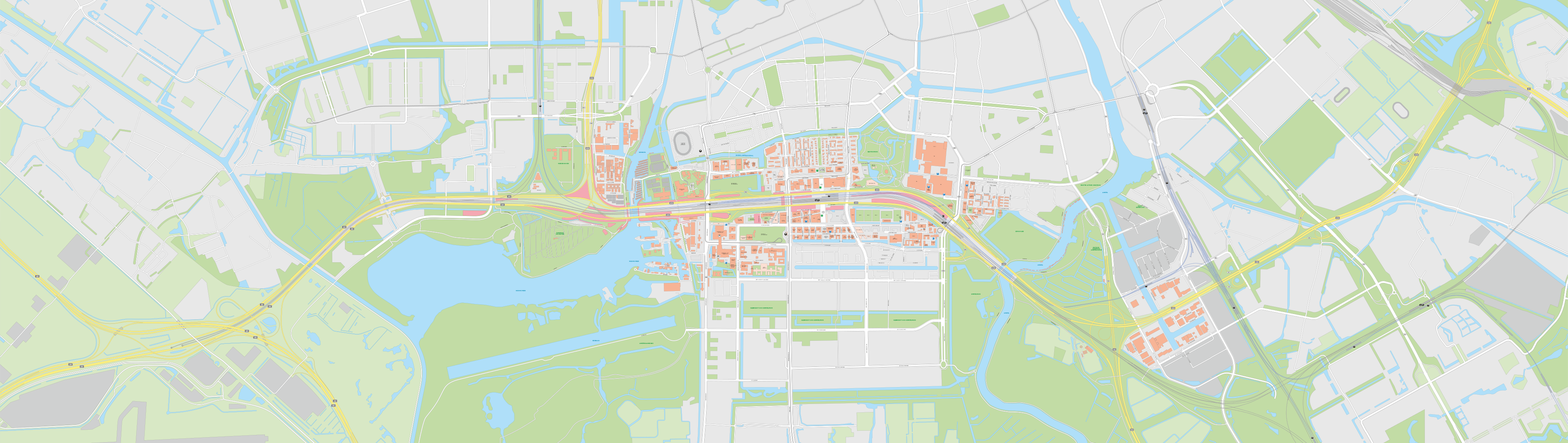
The widening of the A10 Zuid is part of the reconstruction of the De Nieuwe Meer junction being carried out by the TriAX Construction Consortium (Besix, Dura Vermeer and Heijmans). In order to be able to widen the A10 Zuid on the north side between Amstelveenseweg and Jachthavenweg, we need to re-route glass fibre cabling that is causing an obstruction. We previously moved the cables to the south side of the A10 Zuid, but that was a temporary solution only. Starting on 3 June 2024, we are moving the cables to their final position on the north side of the A10 Zuid, where a section of the cabling will be routed through a 350 m long underground tube. Installing this kind of cable ducting across such a long area is very much precision work, as John van Beek explains. He is the operational works coordinator for cables and pipelines at the TriAX Construction Consortium. His work involves agreeing the works with the network operators and their (sub)contractors.
Directional drilling
‘We’re installing the cable ducting by means of directional drilling’, says Van Beek. ‘To do this, we drill a long horizontal hole up to 20 m below ground level, through which we pull the cable ducting. We then guide the cabling through that ducting.’ In order to carry out the directional drilling, a special drilling rig will be placed next to Piet Kranenbergpad, just to the west of the Tripolis-Park office building on 3 June 2024. Van Beek: ‘Before we can do that, we first need to put heavy driving plates into position, because the rig weighs between 30 and 35 tonnes. The rig directs a drill into the ground that is gradually lengthened. A special liquid is then injected through this to remove the excavated earth. The drill head has a gyroscope inside it that enables the rig to gauge the course of the bore path – this needs to be precise down to the centimetre.’
Back and forth several times
The result will be a horizontal hole in the direction of the eastern bank of the River Schinkel, next to Jachthavenweg. Initially, this will be a small borehole – a larger hole, with a diameter of 40 cm, will only be created when the drill is retracted along the same route. ‘After that, the drill will then go in the direction of Jachthavenweg again. That’s where the reel will be with the cable ducting that will be pulled through the hole, back to Piet Kranenbergpad’, explains Van Beek.
Schedule
The directional drilling and installation of the cable ducting will take one or two weeks, after which the glass fibre cables will be blown into the ducting using a special technique. The ends of these cables will then be connected to the existing cables in the area and the so-called night-time transfers will take place in July 2024. This is the moment when the new cables are activated and the old cables (currently on the south side of the A10 Zuid) are taken out of use.
Closure of Jachthavenweg
In order to safely carry out the directional drilling, we are closing part of Jachthavenweg starting on 29 May 2024 (see map). After that, Jachthavenweg will remain closed until 2031 and will be used as a construction site and road. Jachthavenweg will disappear completely as a cycle path. Ultimately, this will be a path for pedestrians.
De Nieuwe Meer junction
The structural renewal of the A10 Zuid is part of Zuidasdok and begins with the large-scale reconstruction of the De Nieuwe Meer junction. The contract for this project was awarded in 2022 to the TriAX construction consortium (Besix, Dura Vermeer and Heijmans). We are building a new flyover and bridges across the Schinkel and widening the A10 Zuid from four to six lanes in each direction. Local traffic and through traffic will be separated from each other. We are creating the space needed to improve traffic flow on the A10 Zuid and make it safer. To enable this to happen, major changes are required on the De Nieuwe Meer junction and later also on the Amstel junction.
Share article:
Give your opinion
Get in touch with us