
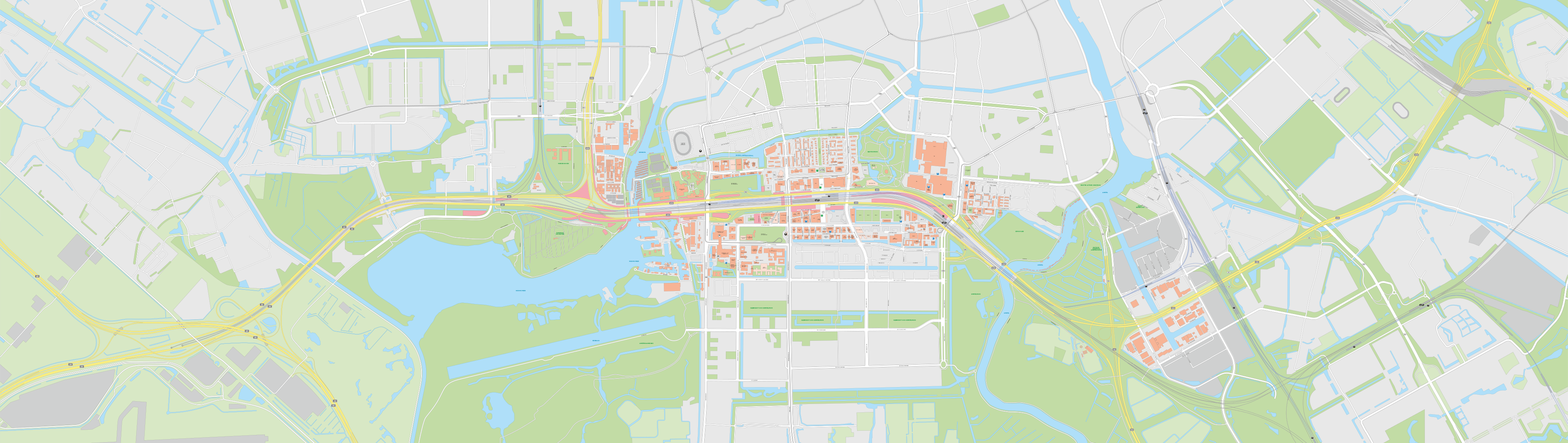
Anyone who looks upwards as they pass through the metro access gates in the passageway at Amsterdam Zuid station will see a blue sky on fine days. Or grey, of course. But, from 5 August, that will no longer be possible, because the roof of the passageway, the Minervapassage, will then be closed again. That is the day when we will be moving the last-but-one section of the new roof into position. (And it’s not simply a case of pushing it into place, as you will find out below). A week earlier, on 29 July, we will do the same thing for the future second station passageway at Amsterdam Zuid station: the Brittenpassage.
Watch the action yourself!
You can watch us move the roof sections live on our webcams. The following times will be particularly worth watching (subject to changes):
Brittenpassage Monday, 29 July between 09.00 and 11.00
Minervapassage Monday, 5 August between 10.00 and 21.00
Minervapassage Tuesday 6 August between 21.00 and 23.00 and during the morning of Wednesday 7 August
Two roof sections
The 70 m long roof section for the future Brittenpassage (the seventh and last one) has been ready and waiting on our work site next to Parnassusweg for a while now, and just needs to be moved slightly further to the north on 29 July. But moving the 100 m long roof section for the Minervapassage will be slightly more complicated. This is because it is on top of a roof section that we built earlier.
Making the move
On the lower roof section, we have placed six steel beams – the first part of a runner. On top of that, is the new roof section for the Minervapassage. On 5 August, we will be moving it from the section underneath it around 16 m to the north. Before that, we will extend the six yellow beams to create a complete runner supported by foundation piles. This will provide us with enough space to use four small hydraulic cylinder jacks to move the deck slightly in order to create space for four larger jacks (the heaviest weighing around 1,000 kg). They will then push the deck in short spurts to the north to its final destination, parallel to the A10. During the move, there will be a cable to measure the distance from the jacks using sensors. This enables us to check that the deck is moving at the same rate across the whole of the runner.
Jack
A jack is similar to a bicycle pump, but filled with liquid rather than air. As more and more liquid is injected into it, that liquid is pressurised (just as air is pumped into your tyre with a bicycle pump). This creates the pressure needed to push the roof section across the runner.
Temporary supports
The end of the runner rests on temporary supports, at a distance of exactly 15.7 m. Using several small, powerful jacks, we will lift the deck upwards around 50 mm in order to remove the runner. But even after that, the deck will still be too high: it was built on top of the existing roof section and actually needs to be at the same height. In order to allow it to be lowered to the right height, we need to shorten the temporary supports by around 2 m. Only then will the deck come to rest in its ultimate position on top of the abutments on either side of the passageway.
Lowered by 2 m
The temporary supports appear as if they have been inspired by the popular game Jenga. In order to lower the deck, we will remove the steel beams layer by layer. Before that, we will use the jacks to support the two outermost beams enabling us to remove the two beams in the centre (after briefly lifting the deck). We will then turn things around: the jacks will be on the outside, enabling us to remove the two beams left in the centre. We will then repeat this for each layer, until the bottom of the deck reaches 4.928 m above sea level. It will then be at the same height as the deck next to it. It will also be at the height required to raise the height of the roof of the Minervapassage from 2.5 m to 4 m – just like under the railway tracks.

Putting the track back in place
Once the two roof sections are finally in place, we will put back in place the northern metro track that we previously removed. This is the second step in the process of bringing all of the metro and railway tracks to the right height: the North/South line platform has already been raised in height. In 2025, we will raise the height of the final, most southerly metro track. By then, all of the tracks at the station will be at the same height, and we can continue work on the regeneration of Amsterdam Zuid station. This is because all of the metro platforms that have been raised are temporary only. We will be building new metro platforms between the existing Minervapassage and the new Brittenpassage. The Brittenpassage is set to open by 2027 at the latest, after which we will be able to continue to extend the Minervapassage, and this is scheduled to be completed by 2031.
Regeneration of Amsterdam Zuid station
In the summer of 2024, we will be working for a full seven weeks on the regeneration of Amsterdam Zuid station. We are removing the most northerly metro track. This will enable us to build a new metro viaduct above Parnassusweg and raise the height of the metro viaduct above Beethovenstraat. We will then be able to move the roof of the Minervapassage and the Brittenpassage into position. You can watch how we are regenerating the station in phases here (in Dutch).

Share article:
Give your opinion
Get in touch with us