
‘Normally, it takes around six months to build a new viaduct’, says Jurri-Jan Vrielink, chief planning engineer at the Nieuw-Zuid construction consortium (Mobilis, Boskalis and Van Gelder). ‘That’s just not possible in this case, because we have to deal with trams, road traffic, cyclists and pedestrians in Parnassusweg. We’ll be doing demolition work and transporting materials, including prefab – an incredibly complex task amid so much activity. To keep disruption to a minimum, we’ll be doing the work during the seven-week closure of the most northern metro track (6 July until 26 August 2024). During that time we’ll be working non-stop 24 hours a day. That’s the only way we can get the job done within seven weeks.
Why a new metro viaduct?
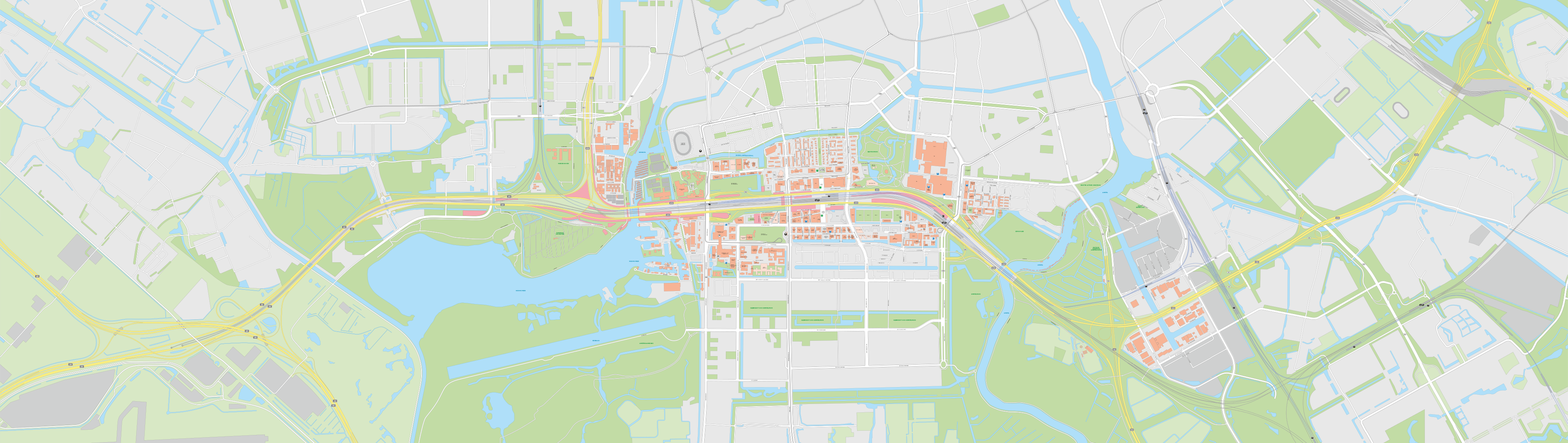
We are moving the most northerly metro track (used by lines 50 and 51 in the direction of Isolatorweg) slightly further to the north. This is necessary in order to make room next to the new passenger tunnel at Amsterdam Zuid station, the Brittenpassage, for the metro platforms we are building there. Currently, the northern metro track still drops down slightly at this point. In order to move the track (M2, see map) to the north, a new viaduct needs to be built that will be slightly further to the north than the existing one. At the same time, we are demolishing part of the existing metro viaduct on which the track in question was until now. We are not completely demolishing this metro viaduct, because there is another track on it (M4) that is intended to transport metros to the railyard next to Amstelveenseweg. In addition, this track could also be used to extend the North/South Metro line in the future.
Hydrodemolition
We need the first two weeks for the demolition of a section of the existing metro viaduct. Vrielink: ‘We’ll start by removing the metro track. After that, we’ll cut into the section of the roof that needs to be lifted out. That way, you have separate beams of concrete that can be hoisted out one by one. A special technique is used to cut out the concrete, known as hydrodemolition. Vrielink: ‘Using this method, you start by cutting into the concrete before applying high-pressure jets of water to remove it. This has the advantage that the reinforcement remains in place. This is necessary because part of this viaduct needs to remain intact and we’re only demolishing a part of it. Using hydrodemolition, the reinforcement on the remaining section stays intact and you don’t do too much damage, making it easy to pour concrete to repair it.’
Dismantling, A10 Zuid closes 12-15 July
In the weekend of Friday, 12 until Monday 15 July, we will be dismantling a section of the existing viaduct beam by beam. We will then lift out all of the sections that we have cut into and transport them away via the A10 Zuid, wich will be closed that weekend. There’ll be a large crane on the motorway and two in Parnassusweg’, says Vrielink. ‘The work will involve around 16 lifts and, don’t forget, it will take around 20 hours to complete. Obviously, this work could have been done many times faster if this viaduct was in the middle of nowhere. But, in this case, we’re dismantling it very carefully section by section.’ After the beams of concrete have been taken away, the existing abutments can be (partially) demolished.
Building at pace
Starting from 18 July 2024, we will proceed at pace with the construction of the new metro viaduct, where we made preparations earlier this year. We have already prebuilt some of the new supports for this and we will finish building them when the road is closed. We’ll insert piles into the ground on both sides of the new viaduct, on which we will build abutments to which beams will be fitted. ‘In order to hoist them into position, we will again need large cranes, this time in Parnassusweg only. Over three nights, we’ll then hoist 18 beams into position’, says Vrielink. And this is still not the end: we will then build a roof on top of the beams. We will first make the reinforcement for this, before pouring the concrete on 5 August. ‘Starting on 4 August, we will install a platform around the new viaduct so that the subsequent works no longer cause disruption to traffic on Parnassusweg.’
Finishing, track back in place, work platform removed
Finally, we will put the finishing touches on the new metro viaduct before putting the track back in place on 14 August. The last two weeks will be used to do the finishing work and the work platform put in place will be removed at the end of August. ‘An awful lot needs to happen in a short space of time’, says Vrielink. ‘Demolishing an existing viaduct is particularly unpredictable: we are reliant on old archive drawings and never know what we’ll encounter when we actually start the work. That’s another reason for working non-stop 24 hours a day: it gives added flexibility. It will certainly be a challenge, but we’ll get it done in time.’
Summer work from 6 July until 25 August 2024
The works being carried out in the summer of 2024 are all part of the larger regeneration of Amsterdam Zuid station. Between 6 July and 26 August 2024, we will be working 24 hours per day, seven days per week at four different locations: next to Parnassusweg, on the future Brittenpassage, the existing passenger tunnel (Minervapassage) and next to Beethovenstraat. During this period, the metros will run a modified service and there will be intermittent closures of the station, Parnassusweg and the A10 Zuid. Read more about the works and disruption here.
Share article:
Give your opinion
Get in touch with us