
In the new Brittenpassage, there will be shops, stairs and escalators, lifts, a ticket service and an indoor bicycle park for 2,600 bikes with direct access from Parnassusweg. Thanks to the materials used and huge amounts of natural daylight, the passenger tunnel promises to be very easy on the eye. According to Van Lochem, all of this will help to resolve the most important challenge in the design: ‘Above all, it needs to become a place where the growing number of passengers can walk safely and comfortably to the train, metro, bus and tram.’
Easily navigable entrance
When it opens in 2027 at the latest, passengers will walk past a large, blue sign above the entrance, just like the one currently hanging above the entrance of the existing Minervapassage. This is a temporary solution, with a subtle message. Van Lochem: ‘That recognisable and eye-catching entrance is in stark contrast to the calm and tranquillity of the new, ultimate appearance of the passageway directly behind the access gates. This emphasises that the entrance is temporary. It also ensures that the entrance is easy to find, especially for passengers who do not visit the station on a daily basis. This will be particularly important when, just in front of the passageway, we divert the A10 Zuid underground. When that happens, the outdoor area will turn into a massive construction pit. That’s why the blue entrance is also temporary.’
Passenger information
To the right of the entrance in Arnold Schönberglaan (and next to the northern entrance in Eduard van Beinumstraat on the left-hand side), there will be an intimation point, where passengers can buy public transport tickets. ‘We’ve deliberately positioned that information point in a sheltered area away from the hustle and bustle, so that passengers in a hurry can enter the station quickly.’
Simple materials
Inside the passage itself, the simple choice of materials is obvious: stone, glass and steel. ‘Natural stone gives the floors and walls a robust and state-of-the-art look’, explains Van Lochem. ‘It brings calm to the passageway and also gives it stature, like other major stations across the world. And it doesn’t necessarily have to be too expensive: the steel access gates, the seating and the waste bins are actually standard models that you see at stations everywhere.’ Functionality has also not been overlooked, she adds quickly: ‘For example, the natural stone tiles for the floors were the subject of extensive testing: they are solid, resistant to wear and tear and therefore safe.’
Comfort and safety
Where the entrances to the platforms are, the roof is made of glass panels that allow light to penetrate from outside. Although this may be slightly more expensive than concrete ceilings in terms of management and maintenance, Van Lochem says that the commissioning authorities ProRail and the City of Amsterdam deliberately opted to make this investment. ‘In that kind of tunnel, people automatically move towards the light. The advantage of that here is that they can easily find the entrances to the platforms.’ Van Lochem laughs: ‘And, of course, sunlight costs nothing.’ An additional benefit is the fact that a well-lit space gives a sense of safety. This is why the shop frontages and the lifts to the platforms are also made of glass – that way, you can always see the rest of the passageway.
Sustainable choice
There is real attention to detail in the finishing, as seen in the perforated ceiling panels that ensure pleasant acoustics within the passageway. ‘The station needs to become a real part of its surroundings. In Zuidas, there are already enough impressive buildings. That meant we could focus on state-of-the-art finishing within the passageway itself. This is also more sustainable: a building that’s not there doesn’t need to be cooled and heated with a climate system that eats energy.’
Access gates
Even the location of the access gates at the entrance has been carefully considered. At the southern entrance in Arnold Schönberglaan, the ones for the metro are on the left and those for the train are on the right. ‘The idea is to enable passengers to find the shortest route to the platforms without obstruction’, explains Van Lochem. ‘From the entrance on the south side, you can go straight via the NS gates on the right-hand side and access the railway platforms via the stairs, escalator or lift. The same principle applies to the entrance on the north side, but in that case the metro tracks are the closest. That means that you can go straight to the metro platforms via the metro gates on the left.’
Amsterdam Zuid station to become increasingly busy
According to predictions, Amsterdam Zuid station is set to become increasingly busy in the years ahead. Pedestrian Flow Consultant Jeroen Stegeman explains: ‘Currently, around 150,000 public transport passengers use the station every day. To reach these figures, we count someone who arrives at the station in the morning and leaves again in the afternoon as two passengers. That number is expected to reach a total of around 300,000 by 2030 – in other words it’s set to double.’ This kind of prediction is based on such variables as the number of jobs there will be in the local area and the expected number of homes. These figures are also used to calculate the number of access gates needed for the safe flow of passengers. Stegeman: ‘In this, we take account of the peak crowds that occur after the arrival of a full train or metro and the time someone needs to check in or out.’
Better access to Kenniskwartier
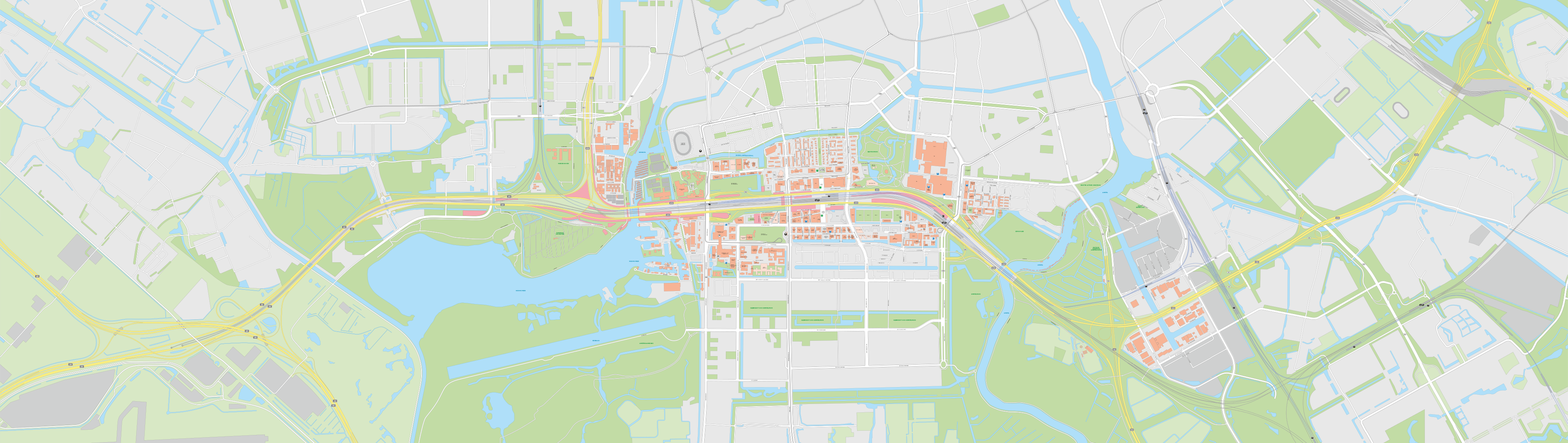
According to Van Lochem, all of these design choices will result in a comfortable and safe additional station passageway. But the design process actually started with a choice of location. Van Lochem points out that it did not take long to choose the west side of the Amsterdam Zuid station, close to the Kenniskwartier, Amsterdam UMC (location VUmc) and the Vrije Universiteit (VU). ‘With the construction of thousands of homes (see, for example, The Pulse of Amsterdam, Stepstone and Ceci, Ed.) and all of the developments on the VU Campus, the Kenniskwartier is set to become the big new passenger magnet for Amsterdam Zuid station. From the Brittenpassage, you walk straight into that bustling part of the city.’
It is already possible to admire the new Brittenpassage by taking a virtual tour in our Zuidas-Zuidasdok Information Centre
- WTC, Toren 5, central foyer
- Strawinskylaan 59
- Monday to Thursday, from 10.00 to 16.00
Share article:
Give your opinion
Get in touch with us